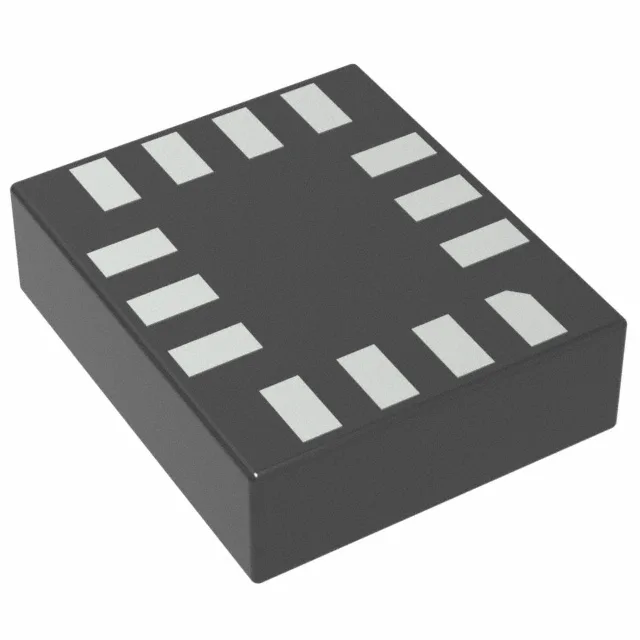
STMicroelectronics IIS3DWBTR — Discrete Semiconductors

STMicroelectronics IIS3DWBTR accelerometer, 5 kHz bandwidth

MPNIIS3DWBTR
End of Life

STMicroelectronics IIS3DWBTR, ECOPACK® series, 3-axis digital accelerometer, X Y Z, 5 kHz bandwidth, ±2g/4g/8g/16g, I²C SPI, 14-VFLGA module, -40°C to 105°C.

$22.56Ref. price · indicative, final on quote
Packaging14-VFLGA Module
SeriesECOPACK®
Independent supplier — new & surplus stockAuthenticity-screened · ESD-safe packingListing updated Aug 2026

Specifications

IIS3DWBTR specifications
ParameterValue
TypeDigital
SeriesECOPACK®
Output typeI²C, SPI
MountingSurface Mount
Supply voltage2.1V ~ 3.6V
Operating temperature-40°C ~ 105°C
Bandwidth5kHz
AxisX, Y, Z
PackageTape & Reel (TR); Cut Tape (CT)
FeaturesTemperature Sensor
Case14-VFLGA Module
Acceleration range±2g, 4g, 8g, 16g
Sensitivity (LSB (g))16393 (±2g) ~ 2049 (±16g)

Product details

5 kHz bandwidth in a 2.5×3 mm LGA

The IIS3DWBTR is a 3-axis digital accelerometer from STMicroelectronics that samples vibration and motion up to 5 kHz — an order of magnitude wider than typical industrial IMUs that top out around 400 Hz. The 14-VFLGA module (2.5×3 mm body, 14-LGA land pattern) keeps the board footprint small enough for handheld tools and embedded condition-monitoring nodes. Output is available over I²C or SPI, so the same BOM position works with a microcontroller that has either bus.

Selectable g-range and on-chip temperature sensor

Four full-scale ranges are selectable: ±2g, ±4g, ±8g, and ±16g. At ±2g the sensitivity is 16393 LSB/g; at ±16g it drops to 2049 LSB/g. For a vibration-analysis application measuring 0.5g peaks at 1 kHz, the ±2g range gives the best resolution — the noise floor on the wide-bandwidth path is low enough that the LSB count matters. That 105°C ceiling covers most industrial enclosures and automotive cabin-mounted modules — the part does not carry an AEC-Q grade, so it is not formally qualified for under-hood or powertrain duty.

Frequently asked questions

What is the closest functional second-source to the IIS3DWBTR?

The IIS2DLPCTR is the closest pin-compatible peer from STMicroelectronics — same 14-LGA footprint, same I²C/SPI interface, same selectable g-ranges. The critical difference is bandwidth: the IIS2DLPCTR tops out at 800 Hz, while the IIS3DWBTR goes to 5 kHz. If your application samples vibration above 800 Hz, the IIS3DWBTR is the correct part; for lower-frequency tilt or motion sensing the IIS2DLPCTR works without a board spin.