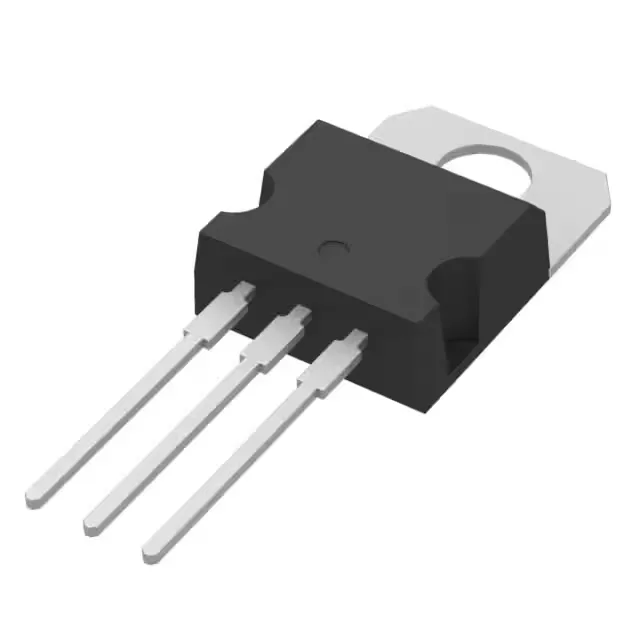
60 V, 20 A per die — the FERD trade-off in a TO-220
Each die is rated for 20 A average rectified current at a 60 V reverse voltage, with a forward voltage drop of 545 mV at 20 A. The fast recovery spec (≤500 ns at >200 mA) makes it suitable for switching power supplies and output rectification stages where conduction loss is the primary concern.
545 mV Vf at 20 A — the conduction loss floor
The forward voltage of 545 mV at 20 A per diode is the headline advantage of the FERD structure over a conventional Schottky of the same voltage rating. At 20 A continuous, each die dissipates roughly 10.9 W — the TO-220 copper tab must be heatsunk to keep the junction below the 150 °C maximum. The trade-off appears in the reverse leakage: 1.1 mA at 60 V, which rises with junction temperature and can erode the efficiency gain if the thermal path is undersized.
Common-cathode pair — one heatsink, two outputs
The 1 Pair Common Cathode configuration shares the centre tab as the cathode connection, so both diodes share the same heatsink surface and the same output node. This is the standard topology for centre-tap full-wave rectifiers and dual-output forward converters — one TO-220 replaces two separate diodes, saving board area and assembly labour. The mounting is through-hole; the tab is soldered or bolted to the heatsink plane.