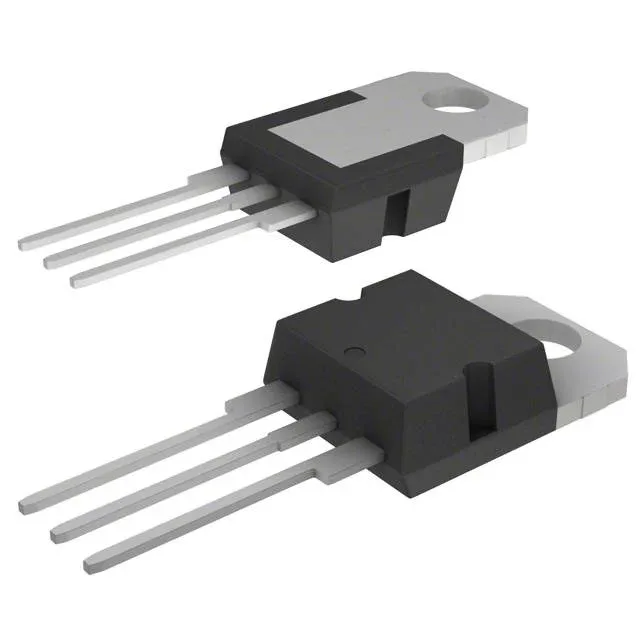
40 A rectifier with a lower Vf floor than a standard Schottky
The STMicroelectronics FERD40H100STS is a 100 V, 40 A Field Effect Rectifier Diode (FERD) in a TO-220AB through-hole package. Its 705 mV typical forward voltage at 40 A is lower than what a conventional 100 V Schottky delivers at that current density, which directly cuts conduction losses in the rectification stage.
At 40 A forward current the Vf is 705 mV, so the conduction loss is about 28 W. That figure sets the heatsink requirement. The junction is rated to 175°C, which gives headroom in a 85°C ambient if the heatsink is sized for the thermal resistance of the TO-220AB tab. Reverse leakage is 190 µA at 100 V — typical for a low-Vf rectifier. The trade-off is that the leakage climbs with junction temperature, so the thermal design should account for the leakage contribution at the operating point.
Active production, ROHS3, through-hole package
The TO-220AB through-hole package is a standard power footprint. For inventory planning, store the tubes in a dry environment — the part is not moisture-sensitive like a surface-mount power package, but the leads should be kept free of oxidation.
FERD vs Schottky — the design trade-off
A FERD (Field Effect Rectifier Diode) uses a field-effect structure to lower the forward voltage below what a planar Schottky of the same voltage rating can achieve. The trade-off is higher reverse leakage at elevated temperature compared to a Schottky. For a 100 V, 40 A output rectifier in a continuous-conduction PFC or a battery charger, the lower Vf saves several watts of conduction loss, which often outweighs the leakage penalty at junction temperatures up to 125°C.