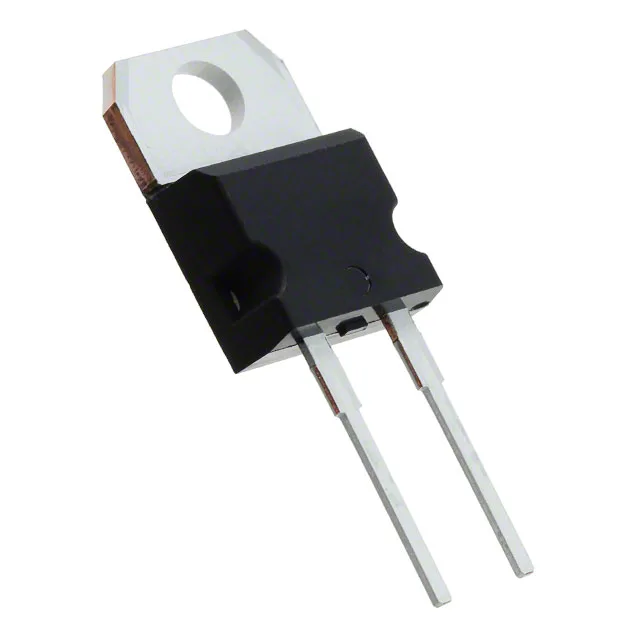
The 40 ns trr makes it suitable for switching frequencies where a standard recovery diode would cause excessive losses or ringing, such as in 50-60 Hz rectification with a capacitive load or in flyback and forward converter output stages.
The BYW81P-200 is listed as obsolete, meaning the manufacturer no longer produces it. Availability is intermittent and pricing is quoted per lot at the time of request. A design review to qualify a modern fast-recovery diode with similar ratings (200 V, 15 A, 40 ns trr or better, in TO-220AC) is the recommended path for new production.
40 ns reverse recovery — the switching-speed edge
The 40 ns reverse recovery time is the headline switching parameter. It means the diode clears stored charge quickly when the voltage reverses, reducing turn-off losses and electromagnetic interference. For a 15 A part, this is a fast-recovery class, not an ultrafast or soft-recovery type. It works well in continuous-conduction-mode boost converters and as a freewheeling diode in low-to-medium frequency PWM motor drives where the switching frequency stays under a few tens of kilohertz. The 1.15 V forward voltage drop at 25 A is a typical figure for this speed class — expect slightly higher conduction loss than a slower 60 Hz rectifier, but the switching loss trade-off is worth it.
Package and mounting — through-hole simplicity
It is straightforward to hand-solder or wave-solder. The tab is electrically connected to the cathode (output), so the heatsink must be electrically isolated or the system must tolerate that connection.