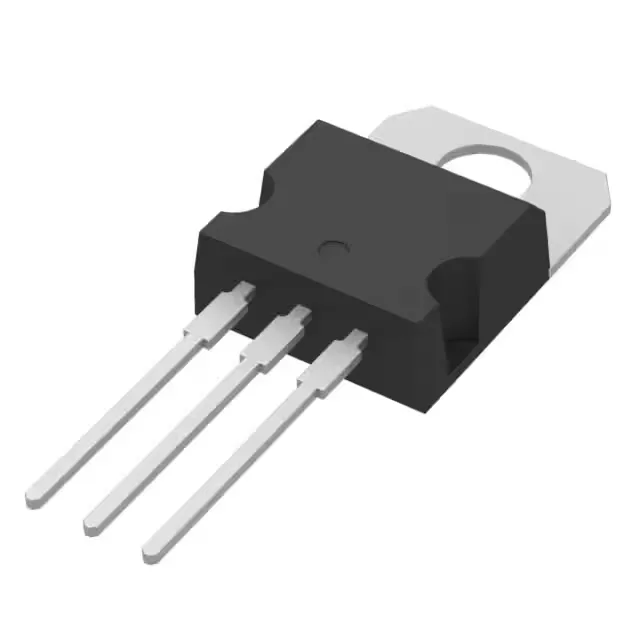
Snubberless™ alternistor — 600 V, 16 A RMS in TO-220
The BTB16-600CWRG is an STMicroelectronics Snubberless™ alternistor triac, rated for 600 V off-state and 16 A RMS on-state current in a TO-220 through-hole package. The Snubberless™ designation means the device is designed for inductive loads without requiring an external snubber network — the internal turn-off commutation is controlled to suppress dV/dt false triggering.
Surge handling and gate drive requirements
Non-repetitive surge current is rated 160 A at 50 Hz and 168 A at 60 Hz — this covers motor-start inrush and capacitor-charging events without exceeding the die's thermal capacity. Maximum gate trigger current is 35 mA and maximum gate trigger voltage is 1.3 V, so standard 5 V logic or a simple transistor driver can fire the gate without a dedicated driver IC. Maximum holding current is 35 mA — once latched, the triac stays on until the load current drops below this threshold at the zero-crossing, which is typical for AC phase-control applications.
Active production, RoHS3, and TO-220 board fit
The TO-220-3 package with through-hole mounting mates with standard 0.100-inch pitch drilled pads and a heatsink tab — the exposed metal tab on the back is the MT2 terminal, so the heatsink must be electrically isolated or at MT2 potential. Operating junction temperature range is -40°C to 125°C, covering industrial and commercial environments including unheated enclosures and motor-drive cabinets.
Drop-in vs the 700 V and 800 V siblings
The BTB16-600CWRG is pin-for-pin and footprint-identical to the BTB16-700BWRG and BTB16-800CWRG — same TO-220 package, same 16 A current rating, same gate trigger specs. The only difference is the off-state voltage: 600 V here vs 700 V or 800 V on the siblings. A board designed for the 700 V variant accepts the 600 V part without rewiring, provided the peak line voltage never exceeds 600 V. The BTA16-600CWRG is electrically identical but uses a different internal die construction (standard triac vs alternistor). The alternistor structure in the BTB16 handles higher dV/dt on inductive loads without false turn-on, so it is preferred for motor and transformer switching.