Active production — timing and transient immunity define the fit
The SI8622BC-B-ISR: Propagation delay is 13 ns max (tpLH and tpHL), with 2.5 ns typical rise/fall time. Pulse-width distortion holds at 4.5 ns max — the channel skew between the forward and reverse paths stays tight enough for SPI clock isolation up to 150 Mbps without bit errors. Common-mode transient immunity is 35 kV/µs minimum. In a motor-drive or inverter application where the switching node slews at 10-20 kV/µs, this isolator rejects the transient without glitching the output — the margin is comfortable for 600 V IGBT bridges.
3750 Vrms isolation and 2.5-5.5 V supply rails
Rated for 3750 Vrms isolation per the capacitive coupling technology. That covers basic insulation for a 240 Vrms working voltage per IEC 60950-1 — suitable for isolating SPI, UART, or general-purpose digital signals between a low-voltage controller and a high-voltage power stage. The -40 °C to +125 °C operating temperature range covers industrial enclosures and under-hood ambient. Two unidirectional channels configured as one forward and one reverse (Inputs - Side 1/Side 2 = 1/1). That matches the common isolation pattern for a UART TX/RX pair or a single SPI signal plus a chip-select feedback line.
Package and compliance — standard SOIC-8, ROHS3
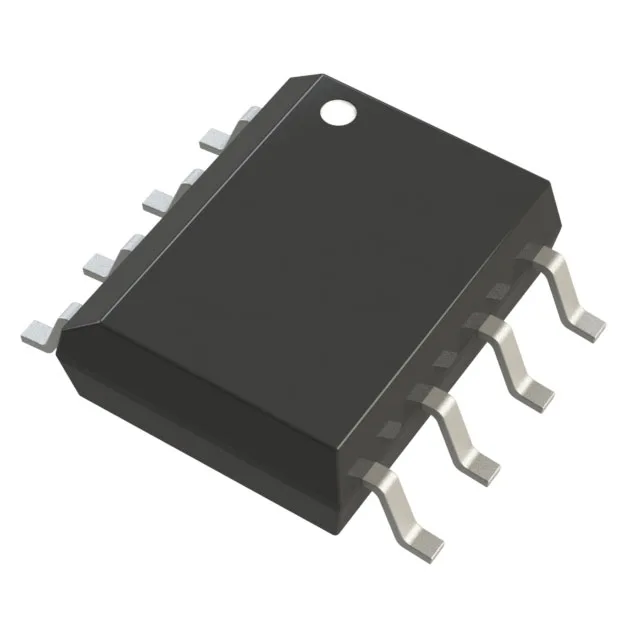
Housed in an 8-pin SOIC (3.90 mm width), supplier device package 8-SOIC. The footprint is standard — no special land pattern or keep-out zone beyond the datasheet recommendation. Surface-mount, tape-and-reel packaging for automated pick-and-place. ROHS3 compliant — no restricted substances above the exemption thresholds.