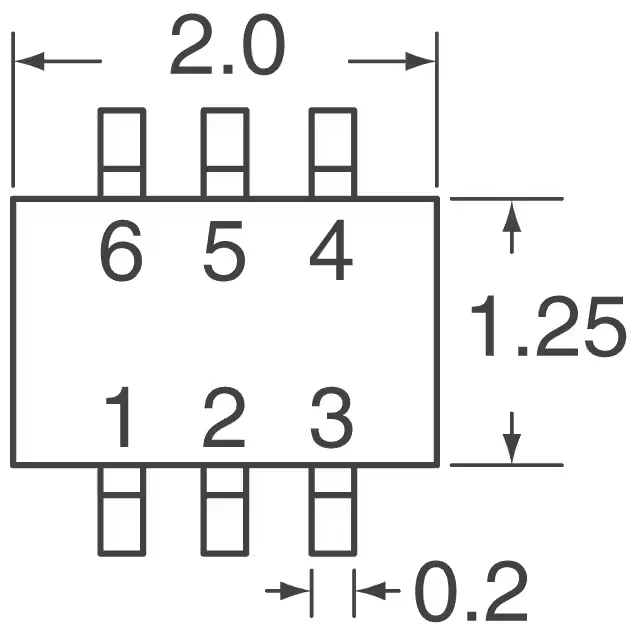
The ROHM UMZ1NTR packs one NPN and one PNP small-signal transistor into a single 6-TSSOP / SC-88 / SOT-363 package, saving board space compared to two separate SOT-23 devices. The NPN side transitions at 180 MHz, the PNP at 140 MHz, making this part suitable for general-purpose switching, signal amplification, and level shifting in compact, low-power designs.
The 50 V VCEO and 150 mA IC limits define the usable operating region for switching loads like small relays, LEDs, or logic-level signals up to 12 V or 24 V rails. The 150 mW package power cap means the total dissipation across both transistors must stay under that limit — if one side runs at 100 mW, the other is budgeted only 50 mW. For continuous duty near the current limit, derate the power or check the on-state voltage drop: VCE(sat) is 400 mV (NPN) and 500 mV (PNP) at 50 mA, so at 150 mA the actual dissipation per transistor can exceed 75 mW, leaving little headroom for the other die.
Transition frequency and gain — signal-path fit
With an ft of 180 MHz (NPN) and 140 MHz (PNP), this part can handle audio-frequency amplification, sensor buffering, and switching up to a few megahertz without significant gain roll-off. The minimum DC current gain (hFE) is 120 at 1 mA, 6 V — a solid baseline for small-signal driver stages. The collector cutoff current is only 100 nA (ICBO), which keeps leakage negligible in high-impedance nodes or battery-powered circuits.
Package and footprint — design-in note
The supplier device package is UMT6 (Rohm's own designation for the 6-pin SOT-363 footprint). The operating temperature range is rated up to 150 °C junction, so the part can sit near warm components or in enclosed modules as long as the 150 mW power budget is respected.
The laser etch and date-code traceability should match ROHM's factory markings for the UMT6 package — any mismatch in font or logo geometry warrants a decap/X-ray check before accepting a non-franchised lot.