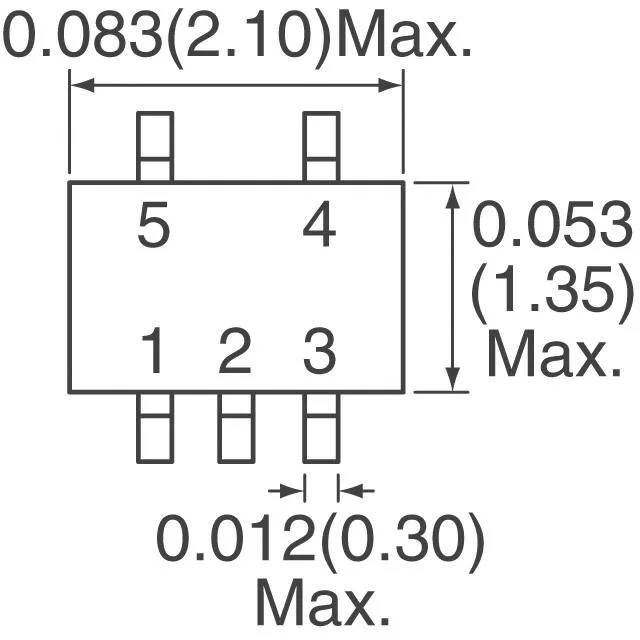
What this dual pre-biased transistor brings to the board
The Rohm UMG1NTR packs two NPN transistors with integrated bias resistors into a single SOT-353 (UMT5) package. Each transistor has a 22 kΩ base resistor (R1) and a 22 kΩ emitter-base resistor (R2), so no external bias network is needed — just connect the base drive and collector load. Transition frequency of 250 MHz is fast enough for typical PWM and serial-data line buffering up to a few megahertz.
The 300 mW maximum power dissipation is the thermal ceiling for the tiny SOT-353 body. At 50 V and 100 mA you are at the absolute edge of the SOA; in practice, derate to keep junction temperature below 150 °C. For continuous 10 mA per channel at 5 V supply, dissipation is about 50 mW — plenty of margin. If you are driving both channels near 100 mA, check the total against the 300 mW limit and watch the copper area under the package.
Built-in bias resistors — BOM simplification
The 22 kΩ base and 22 kΩ emitter-base resistors are laser-trimmed on the die. The base resistor sets the input current for a given drive voltage; the emitter-base resistor speeds turn-off by shunting stored charge. For a 5 V logic drive, base current is roughly (5 V - 0.7 V) / 22 kΩ ≈ 195 µA, which with a minimum hFE of 56 at 5 mA gives plenty of saturation drive for loads up to 10 mA. The saturation voltage is 300 mV maximum at 500 µA base and 10 mA collector — clean logic-level switching.
It is fully ROHS3 compliant.