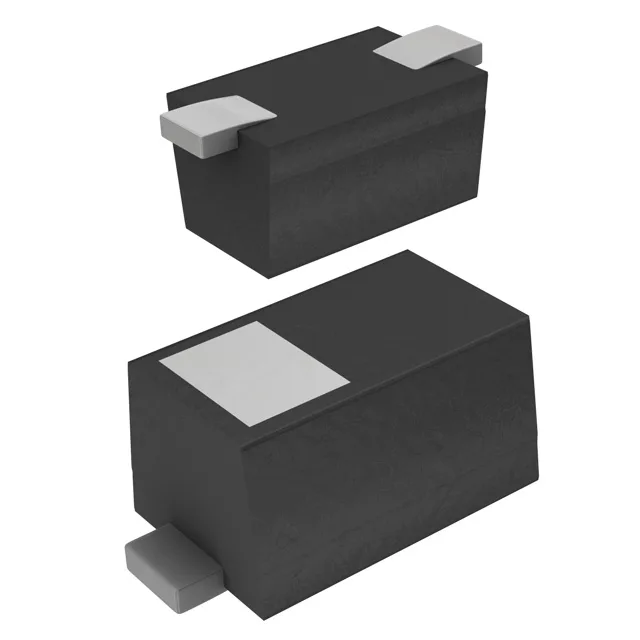
Schottky barrier diode for low-power rectification and protection
The RB500SM-30T2R is a small-signal Schottky barrier diode from ROHM, rated for 30 V reverse voltage and 100 mA average rectified current. It uses Schottky technology for a low forward voltage drop of 450 mV at 10 mA forward current, which keeps conduction losses minimal in low-voltage rails. This part targets applications where a low Vf Schottky is needed for polarity protection, OR-ing diodes, or freewheeling clamps in low-power DC circuits — think portable instruments, battery management, or auxiliary supplies in industrial control modules.
What the 450 mV forward voltage means at the bench
At 10 mA forward current, the Vf max is 450 mV — that's the voltage dropped across the diode when it's conducting. For a 3.3 V rail, that's a 14% drop; for a 5 V rail, about 9%. If your load draws 100 mA continuous, the forward voltage will climb above the 10 mA figure, so budget headroom in the rail voltage or use a higher-current Schottky if the drop eats into the regulation margin. Reverse leakage is 500 nA max at 10 V reverse bias. That's low enough to not drain a coin cell or affect a high-impedance sense node, but it doubles with temperature — at 85 °C junction, expect leakage to rise into the microamp range. If the diode sits on a 24 V bus, the leakage at 30 V reverse will be higher than the 10 V spec, so derate accordingly.
SOD-523 footprint and reflow reality
The RB500SM-30T2R comes in a SOD-523 package (also designated SC-79), a tiny 1.6 mm × 0.8 mm body with 0.50 mm pitch leads. That footprint is common for small-signal diodes, but the pad dimensions are tight — the solder paste stencil aperture needs to be matched to the copper land to avoid tombstoning during reflow. Mounting is surface-mount only.
Active production — no last-time-buy risk
ROHS3 compliance is confirmed, so it's suitable for new designs bound for EU or RoHS-regulated markets.