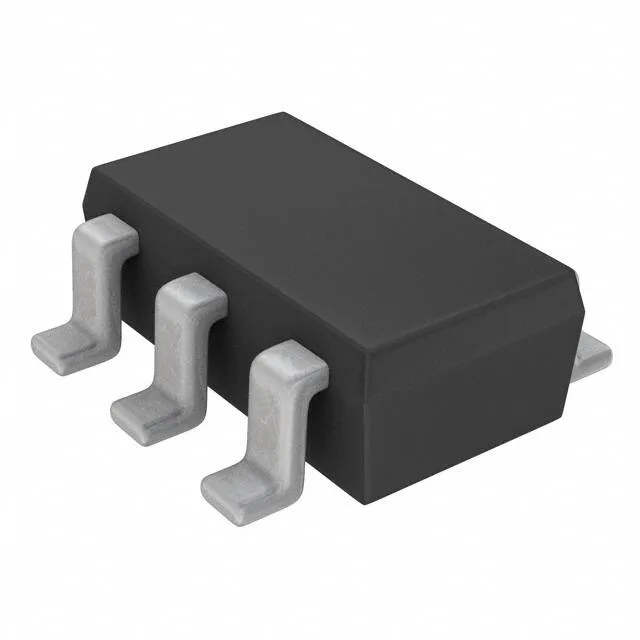
Dual PNP in a TSMT6 footprint
The ROHM QST8TR packs two PNP transistors into a single TSMT6 (SC-95) surface-mount package, saving board space compared to two discrete SOT-23s. The dual PNP configuration is useful for current-mirror loads, push-pull output stages, or driving two independent loads where the common-emitter topology is preferred over NPN. The 1.25 W total power dissipation (package-limited) means each transistor shares the thermal budget; for continuous operation above 500 mA per channel, the PCB copper area and ambient temperature need to be factored in.
Switching and saturation performance
A Vce(sat) of 200 mV at 500 mA collector current (with 25 mA base drive) keeps conduction losses low in saturated switching. The 100 nA maximum collector cutoff current (ICBO) at 25 °C means negligible leakage in off-state, important for battery-powered or high-impedance nodes. The 400 MHz fT gives usable gain well into the tens of MHz, so the QST8TR can serve as a pre-driver for higher-power MOSFETs or as the active element in a 1–10 MHz DC-DC converter's error amplifier or level shifter. At 150 °C junction temperature rating, the part is specified for industrial environments where local heating from adjacent power components is expected.
Package and thermal notes
The TSMT6 (SC-95) is a thin SOT-23-6 variant with a 1.1 mm max height, suitable for low-profile designs. The 1.25 W power dissipation is the absolute maximum at 25 °C ambient; derating is required above that.