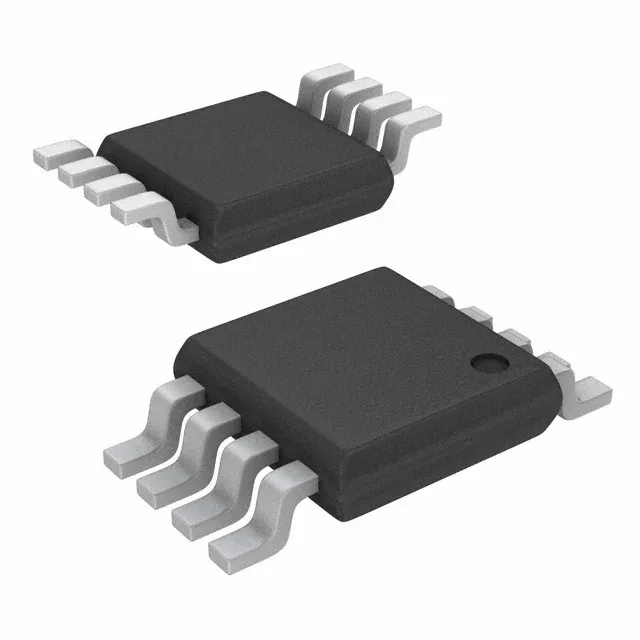
Dual op-amp for industrial signal chains
At 3.5 V/µs the LM4559FVJ-GE2 can swing a 10 V peak-to-peak sine wave up to roughly 55 kHz before the output starts to slew-limit. That's enough for most audio paths, motor-current feedback loops, or low-speed data acquisition. The 4 MHz GBW tells you the open-loop gain drops to unity at 4 MHz; for a closed-loop gain of 10, expect a usable bandwidth around 400 kHz. Neither spec is record-breaking, but both are solid for a general-purpose dual op-amp that draws only 3.3 mA quiescent per amplifier.
Supply range and input offset
The 8 V minimum supply means this part does not run on a 5 V rail — it needs at least 8 V, so plan for a 12 V or 24 V supply in industrial gear. The 500 µV input offset voltage (max) is typical for a general-purpose bipolar op-amp; if your application needs sub-100 µV offset, you would look at a precision amplifier instead. Input bias current is 40 nA, which is fine for moderate-impedance sources but could cause offset errors with high-value feedback resistors.
No LTB window or successor part has been announced — this is a standard-production dual op-amp you can qualify into a BOM without worrying about a near-term phase-out.