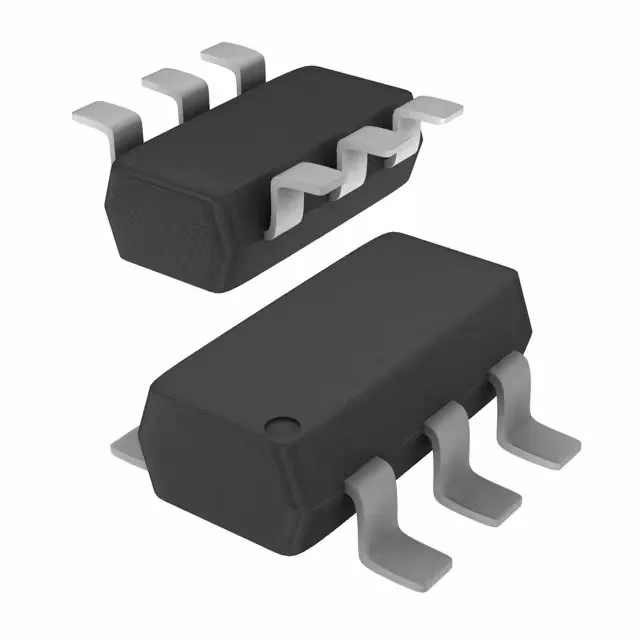
Two NPNs with built-in bias resistors in a single SOT-457
The ROHM Semiconductor IMH23T110 packs two NPN pre-biased transistors into a single SC-74 (SOT-457) surface-mount package. Each transistor integrates the base bias resistor (R1 = 4.7 kOhms) internally, so no external resistors are needed for the base drive — the part switches directly from a logic output. The dual die saves board area and placement cost compared to two discrete transistors plus two resistors. Collector current is rated 600 mA maximum, with a collector-emitter breakdown of 20 V — sized for low-side switching of relays, solenoids, small motors, and indicator LEDs in 5 V or 3.3 V systems. The 150 MHz transition frequency means it handles PWM up to several MHz cleanly. DC current gain (hFE) is a minimum 820 at 50 mA, 5 V, so the base drive current needed is very low — a 3.3 V GPIO with a series resistor can saturate the output. Vce saturation is typically 150 mV at 50 mA, keeping conduction losses low. Total power dissipation for the dual package is 300 mW — derate for ambient temperature above 25 °C; the SMT6 footprint on standard FR4 gives adequate thermal performance for most low-power switching loads.
How the 4.7 kOhm base resistor affects your drive circuit
The integrated R1 of 4.7 kOhms sets the input current for a given logic voltage. At 5 V logic, base current is roughly (5 V - 0.7 Vbe) / 4.7 kOhm ≈ 0.9 mA, which with a minimum hFE of 820 can drive over 700 mA collector current — more than the 600 mA rating. At 3.3 V logic, base current is about 0.55 mA, still enough for several hundred mA of load. Compare with the IMH11AT110 (R1 = 10 kOhms) — the IMH23T110's lower base resistor pulls more base current at the same logic voltage, giving higher available collector current for a given input. If your load is under 300 mA, the IMH11AT110 is also an option; above that, the IMH23T110 is the better fit.
For a pre-biased dual transistor in a mature package (SOT-457), this is a stable, long-availability part — no LTB risk on the horizon.