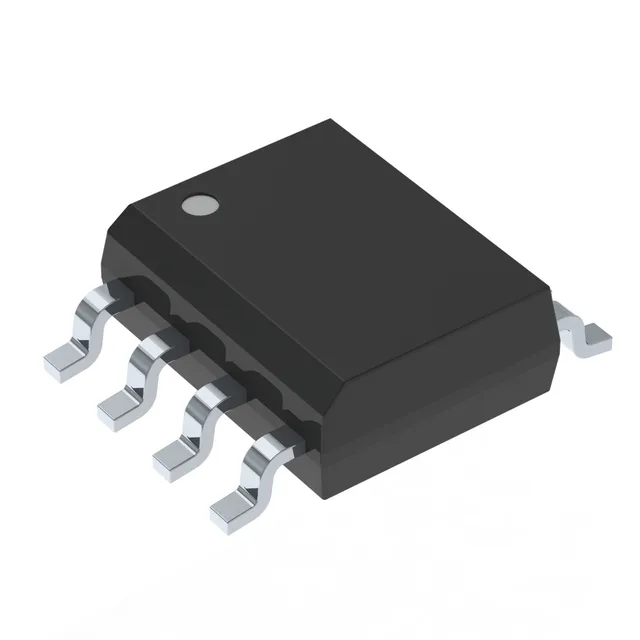
The BV1LC300FJ-CE2: Surface-mount only — the 1.27 mm pitch is a standard footprint that runs on any leaded reflow profile without exotic stencil work. The package itself is rated for that thermal envelope, but the board copper area under the die pad sets the actual RthJA — a 4-layer board with thermal vias is the safe bet if the load runs near the 2.7 A ceiling continuously.
What the 2.7 A and 350 mOhm ratings mean for the load
This is a single-channel low-side N-channel switch with a typical on-resistance of 350 mOhm. At 2.7 A the conduction loss is I²R = 2.55 W — that heat has to go into the PCB copper, not the package leads. The output configuration is low-side with a non-inverting input and a 1:1 input-to-output ratio. The interface is simply On/Off — no Vcc/Vdd supply needed, so it gates the load directly from a GPIO without an extra bias rail.
Fault protection — fixed current limit plus thermal shutdown
Built-in fault protection includes fixed current limiting and over-temperature shutdown. The slew-rate controlled switching reduces EMI on the load edge — useful when switching a solenoid or lamp that would otherwise ring the supply rail. No reverse-battery or load-dump protection is listed, so an external TVS or diode at the input is expected in an automotive module.
Lifecycle and compliance — active production, AEC-Q100, ROHS3
The tape-and-reel packaging (TR) suits volume pick-and-place; cut-tape (CT) is available for prototyping or low-volume builds.