Active 1Kbit EEPROM with wide supply range
The ROHM BR93G46FJ-3AGTE2 is a 1Kbit serial EEPROM organized as 64 words x 16 bits, communicating over a Microwire bus at clock frequencies up to 3 MHz.
Supply voltage — what the 1.7V floor means in practice
The 1.7V minimum operating voltage is the spec that separates this part from older 2.5V-minimum EEPROMs. At the high end, 5.5V lets it sit on an unregulated 5V rail without a series regulator — useful in industrial control panels where the 5V supply is already noisy and you want one less component between the bus and the memory.
Write cycle timing for the production line
Each word or page write takes 5 ms maximum. That matters during factory calibration: if your test fixture writes 64 words sequentially, the total write time budgets to 320 ms plus Microwire command overhead. For a high-volume line running a 10-second test cycle, that's negligible — but if you're doing byte-by-byte updates in the field over a slow bus, the 5 ms per write sets the latency floor for firmware that updates configuration tables.
It covers outdoor telecom cabinets, factory-floor sensors, HVAC controllers, and automotive cabin applications (non-AEC-Q100). If your design lives under the hood at 105°C or 125°C, step up to the BR93A46RFVT-WME2, which carries AEC-Q100 qualification and extends to 105°C — but that part requires a 2.5V minimum supply, so you trade the wide voltage range for the higher temperature ceiling.
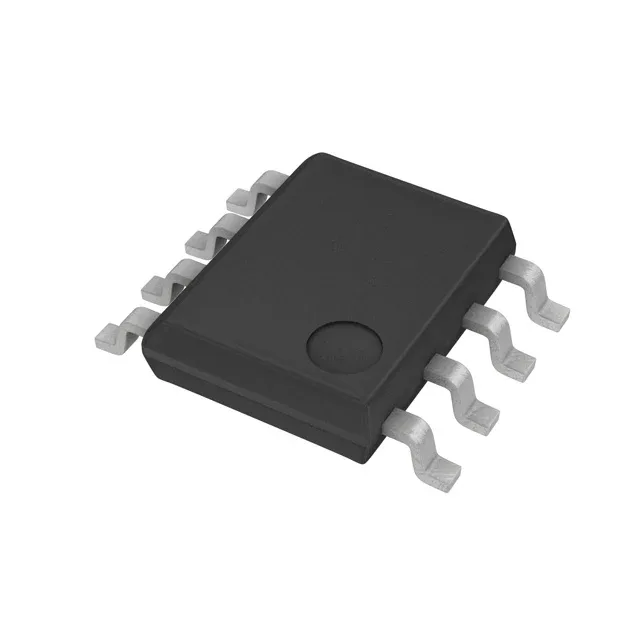
The 8-SOIC package measures 3.90 mm wide — the narrow-body SOIC footprint that is standard for 8-pin serial memories. No exposed pad, no thermal vias needed; the part dissipates negligibly at its operating current. Layout gets the usual 0.65 mm lead pitch and a copper land pattern matching the JEDEC MO-012 variation.