IPM driver with 5000 Vrms isolation for inverter gate drive
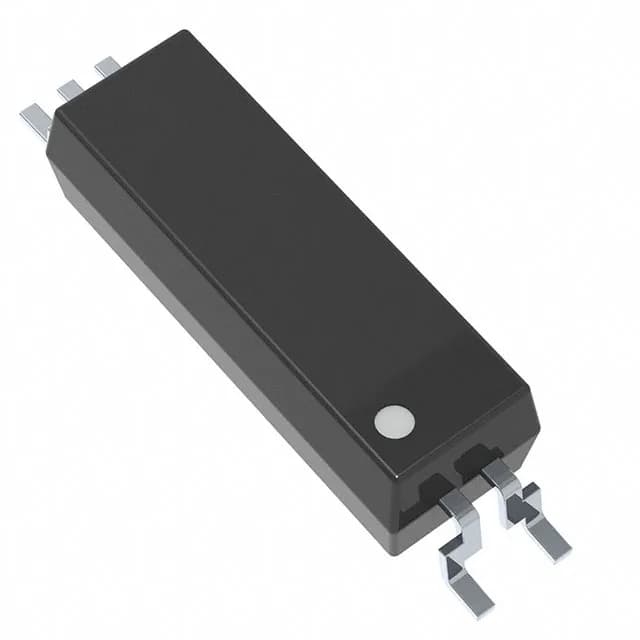
The Renesas RV1S9209ACCSP-10YC#SC0 is a single-channel photocoupler-based IPM driver with a push-pull, totem-pole output stage. It is designed to drive the high-side and low-side IGBTs in a motor-drive inverter, providing reinforced isolation rated at 5000 Vrms. The 50 kV/µs common-mode transient immunity (CMTI) ensures the output stays clean when the floating high-side reference jumps at every switching edge — a spec that matters more than the isolation number itself in a 1200 V inverter bus. The input side is DC-coupled with a typical forward voltage of 1.56 V and a maximum forward current of 20 mA. Propagation delay is 200 ns max symmetrical, which sets the lower bound on dead-time insertion in the PWM scheme. The 5-LSSO package with gull-wing leads (5-SMD, Gull Wing) is a surface-mount form factor common to high-voltage photocouplers.
The 200 ns max propagation delay (tpLH / tpHL) is the same for both edges, so the pulse-width distortion is negligible. In a 10 kHz PWM cycle, 200 ns represents 0.2% of the period — fine for most motor drives. But if you are pushing 50 kHz switching in a GaN or SiC design, that 200 ns eats into the minimum on-time and forces a wider dead-time, which increases THD at light load. The 50 kV/µs CMTI rating means the output will not glitch when the high-side emitter voltage slews at 50 kV/µs — a realistic number for a fast IGBT switching 600 V in 100 ns. Below this threshold, the internal parasitic coupling can momentarily flip the output, which in a half-bridge means shoot-through. This part gives a 3× margin over the typical 15 kV/µs requirement in a standard IGBT module. Rise and fall times are 25 ns and 5 ns typical respectively. The fast fall time (5 ns) helps the gate turn-off quickly, reducing the IGBT's turn-off loss. The slower rise (25 ns) limits dV/dt on the gate, which helps control EMI at the expense of a small turn-on loss penalty.