16-bit RL78/G23 MCU with 384 KB Flash and industrial temperature range
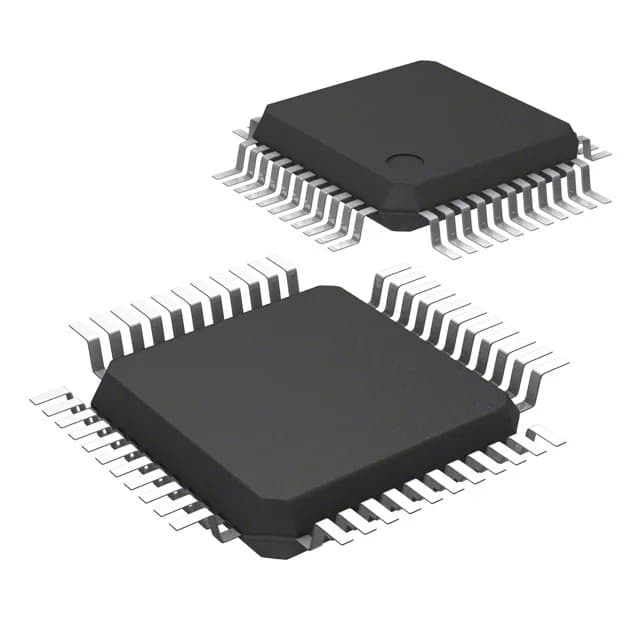
The Renesas R7F100GFK3CFP#HA0 is a 16-bit microcontroller from the RL78/G23 series, built around the RL78 core running at 32 MHz. It carries 384 KB of Flash program memory, 32 KB of RAM, and 8 KB of on-chip EEPROM — enough firmware space for complex control algorithms and data logging without external storage. The operating temperature range is -40°C to 105°C. Supply voltage range is 1.8 V to 5.5 V. The 44-LQFP package (10x10 mm body) brings out 37 general-purpose I/O. That pin count suits mixed-signal boards where you need a dozen sensor inputs, a few PWM outputs, and a serial bus or two, all on a compact footprint.
Peripheral set and connectivity
On-chip peripherals include capacitive touch sensing, low-voltage detect (LVD), power-on reset (POR), PWM generation, and a watchdog timer (WDT). The capacitive touch block handles up to several channels without an external touch controller — useful for panel interfaces or appliance keypads. Serial connectivity covers CSI (clocked serial interface), I²C, LINbus, SPI, and UART/USART. The LINbus interface makes this MCU a natural fit for automotive body-control nodes — window lifts, seat adjusters, or HVAC actuators — where a LIN slave node needs local intelligence. The analog subsystem provides a 10-channel ADC with selectable 8-, 10-, or 12-bit resolution, plus two 8-bit DAC channels. That resolution range lets you trade conversion speed against precision: 12-bit for sensor conditioning, 8-bit for fast overcurrent detection. An internal oscillator is included, so the MCU can run without an external crystal for cost-sensitive or space-constrained designs. For applications requiring tighter timing accuracy, an external clock source can still be fed in.
Memory architecture and firmware strategy
The 384 KB Flash is organised as 384K x 8 bits. That is enough for a full-featured firmware image with a real-time operating system, communication stacks (I²C, SPI, LIN), and application logic — no need for external Flash in most designs. The 8 KB EEPROM is separate from the Flash, so calibration constants, production trim values, or fault logs can be updated without erasing and rewriting program memory. That avoids the wear-leveling complexity of emulated EEPROM in Flash. 32 KB of RAM supports moderate data buffering — enough for a few hundred sensor readings, a small display frame buffer, or a command queue for serial communication.
Lifecycle and sourcing
The R7F100GFK3CFP#HA0 carries an Active lifecycle status from Renesas. New designs can commit to this MPN without near-term obsolescence risk. The part is ROHS3 compliant, meeting the latest EU restriction directive for lead-free soldering processes.