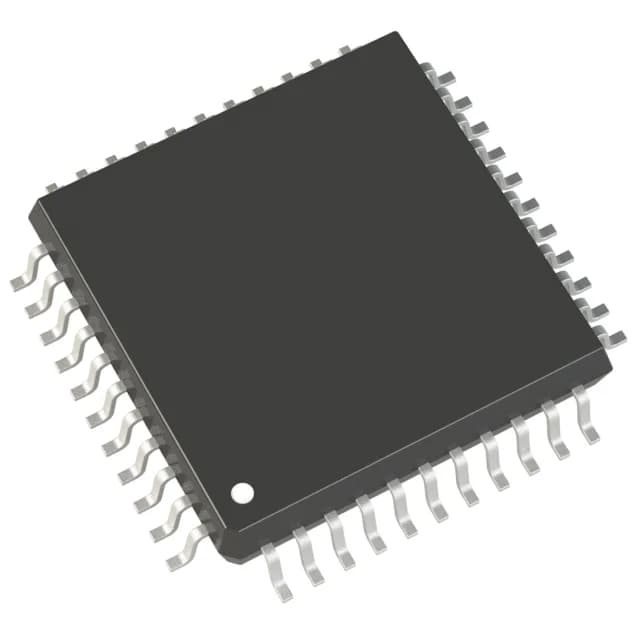
96 KB Flash in a 44-LQFP — the mid-range RL78/G23 workhorse
It runs at 32 MHz from an internal oscillator, so no external crystal is needed for basic clocking. The supply range goes down to 1.6 V, which suits battery-powered or energy-harvesting sensor nodes where every millivolt of headroom matters.
On-chip analog and touch — what it saves on the BOM
This MCU integrates a 10-channel ADC that can be configured for 8-, 10-, or 12-bit resolution, plus two 8-bit DAC outputs. That means a single-chip solution for reading multiple analog sensors (thermistors, potentiometers, current shunts) and generating analog reference or control voltages without external converters. The capacitive touch sensing peripheral is a genuine BOM eliminator for membrane-button or proximity interfaces in white goods, appliances, and control panels.
Serial interfaces for fieldbus and sensor links
Connectivity covers CSI (clocked serial interface), I²C, LINbus, SPI, and UART/USART. The LINbus support makes this a candidate for automotive body electronics (door modules, seat controllers, lighting nodes) where a LIN slave is needed. The I²C and SPI ports handle local sensor hubs, EEPROM, or display drivers. With 37 I/Os available, you can keep a parallel LCD or a keypad matrix without a port expander.
Renesas lists the R7F100GFF2DFP#HA0 as Active. No urgency to qualify a second source today, though the RL78/G23 family has several pin-compatible siblings if you need more I/O or a wider temperature range later.
Temperature grade and environment
If your design lives under the hood or near an engine block, step up to the RL78/G23 variant with the extended temperature option.