RL78/G23 16-bit MCU with 192 KB Flash and capacitive touch
The Renesas R7F100GBH2DFP#BA0 is a 16-bit MCU from the RL78/G23 series, built around the RL78 core running at 32 MHz. It packs 192 KB of Flash program memory, 20 KB of RAM, and 8 KB of on-chip EEPROM. The supply range is 1.6 V to 5.5 V, and the temperature grade is -40°C to 85°C.
Memory and peripheral fit for HMI and sensor fusion
The 192 KB Flash and 20 KB RAM provide comfortable space for a capacitive-touch firmware stack plus a LIN or I²C communication protocol without external memory. The 8 KB EEPROM is useful for storing calibration constants, configuration profiles, or fault logs — no separate serial EEPROM needed on the BOM. The capacitive touch peripheral supports touch-button or slider interfaces, which is why this part often shows up in appliance control panels and industrial keypads. Connectivity options include CSI, I²C, LINbus, SPI, and UART/USART — enough to talk to sensors, displays, and a LIN bus in automotive body modules.
32 MHz RL78 core and data converters
The RL78 core at 32 MHz delivers deterministic interrupt response and low-power operation — typical for a 16-bit MCU targeting real-time control loops. The on-chip data converters include an 8-channel ADC with selectable 8-, 10-, or 12-bit resolution and a 2-channel 8-bit DAC. That ADC resolution range lets you trade off speed vs precision: 8-bit for fast current-sense reads, 12-bit for slower but more accurate temperature or pressure measurements. The internal oscillator trims the external crystal from the BOM for cost-sensitive builds, though an external clock can still be used if timing accuracy matters.
Package and layout: 32-LQFP, 27 I/O
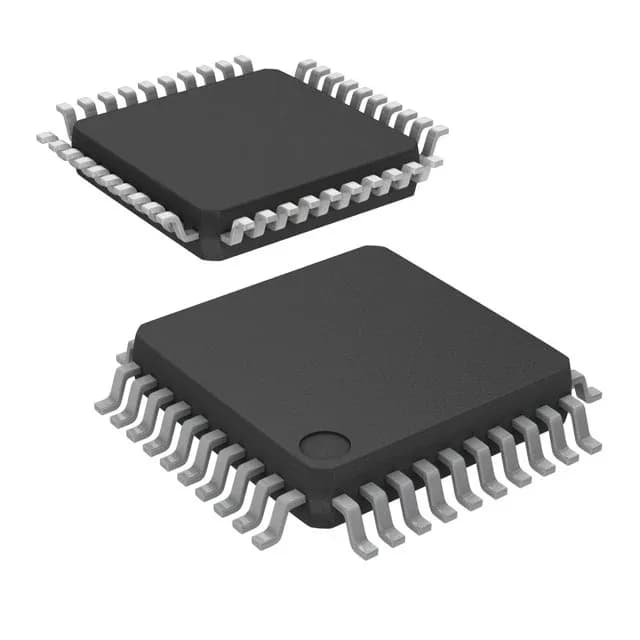
Housed in a 32-LQFP package (7x7 mm body), the R7F100GBH2DFP#BA0 exposes 27 general-purpose I/O pins. The LQFP footprint is straightforward for hand-assembly or reflow.
Lifecycle and compliance: active, ROHS3
It is ROHS3 compliant, which covers the EU RoHS directive without exemptions. The RL78/G23 series is a relatively recent addition to Renesas' 16-bit lineup, so the roadmap looks stable for the next several years.