160 MHz RXv3 core with 256 KB Flash — what the memory budget means
The Renesas R5F566TAFGFP#30 is a 32-bit RXv3 microcontroller from the RX series, clocked at 160 MHz. It carries 256 KB of Flash program memory, 64 KB of RAM, and a separate 32 KB of data Flash EEPROM — the EEPROM block is useful for calibration constants and boot-config parameters that survive firmware updates without wearing the main Flash. The 160 MHz core with the RXv3 pipeline gives enough headroom for a single motor-control loop running field-oriented control at 20 kHz while the CANbus and UART stacks service the host controller.
Peripheral set for industrial control panels
This MCU packs 73 I/O lines and a connectivity suite that covers most industrial fieldbus and human-machine interface needs: CANbus for drive-to-drive networking, LINbus for local sensor clusters, multiple SPI and I²C buses for external ADC or display drivers, and an external bus interface (EBI/EMI) for parallel LCDs or SRAM expansion. The 22-channel 12-bit ADC and dual 12-bit DAC handle analog feedback and setpoint generation on the same chip, which saves a separate analog front-end on a motor-drive board.
Industrial temperature grade — deployment context
Rated for -40°C to 105°C ambient, this part fits factory-floor automation cabinets, outdoor telecom pedestals, and under-hood automotive auxiliary modules (engine bay, transmission controller). The 2.7 V to 5.5 V supply range means a single 5 V industrial rail powers the MCU directly — no intermediate 3.3 V regulator needed unless the peripheral set demands it.
Package and physical fit
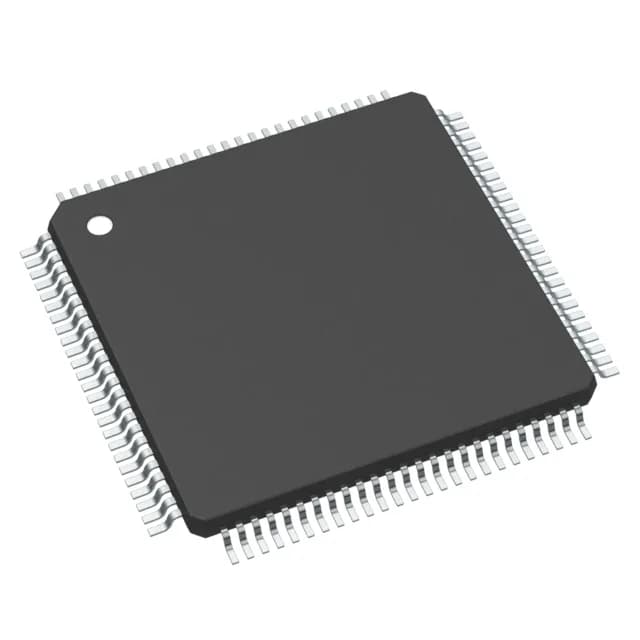
Housed in a 100-LQFP (14x14 mm body, 0.5 mm pitch), surface-mount. The 100-LFQFP supplier package code matches the same footprint. Standard reflow profile for LQFP applies;.
Lifecycle and sourcing posture
Officially active, ROHS3 compliant — no last-time-buy risk for new designs. For dual-sourcing resilience, the R5F566TAAGFP#30 is a functional peer with the same RXv3 core, 160 MHz speed, and identical peripheral set, differing only in I/O count (72 vs 73) — worth qualifying as a second source if your BOM allows the minor pin difference.