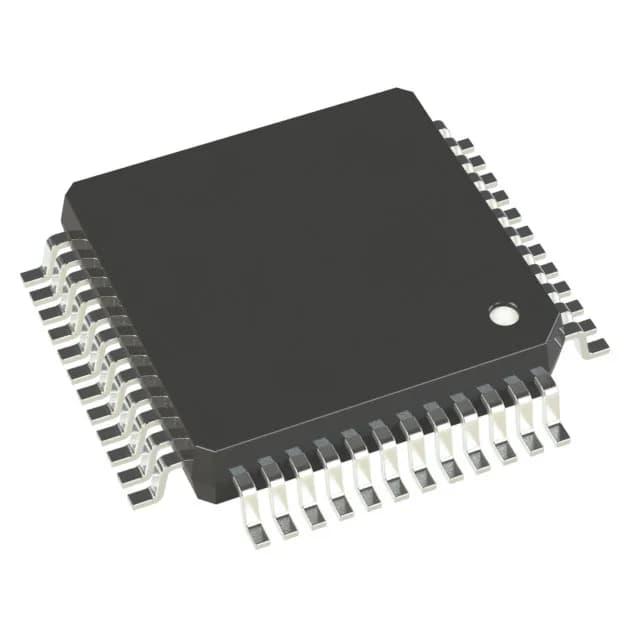
160 MHz RXv3 MCU with on-chip EEPROM — fit for industrial control and CAN-based nodes
The Renesas R5F566TABDFL#10 is a 32-bit microcontroller from the RX family, built around the RXv3 core running at 160 MHz. It packs 256 KB of Flash program memory, 64 KB of RAM, and 32 KB of on-chip EEPROM — the latter saving a board-level serial EEPROM in many designs. The peripheral set includes CAN, I²C, SPI, UART, LIN, SSI, and an external bus interface (EBI/EMI), making it a fit for industrial I/O modules, motor drives, and CAN-based sensor hubs. Operating temperature spans -40°C to 85°C, covering factory-floor and outdoor telecom enclosures without the extended-range premium.
256 KB Flash, 64 KB RAM, 32 KB EEPROM — memory budget for code and data
The 256 KB Flash (256K x 8) and 64 KB RAM handle control firmware and data buffering. The 32 KB EEPROM stores calibration constants and fault logs without an external I²C EEPROM.
Connectivity and analog — CAN, SPI, I²C, 8-channel 12-bit ADC, 2-channel 12-bit DAC
The R5F566TABDFL#10 carries CAN, I²C, SPI, UART, LIN, SSI, and an external memory interface (EBI/EMI). For analog I/O, it integrates an 8-channel 12-bit ADC and a 2-channel 12-bit DAC — enough for current-sense feedback and analog setpoint generation in a motor-drive or power-converter application. The 33 I/O lines in the 48-LQFP package leave room for a parallel LCD or external SRAM via the EBI while still supporting serial peripherals.
Active lifecycle — no LTB risk for new designs
Renesas lists this part as Active (current production). There is no last-time-buy notice or NRND flag. For production BOMs that need dual sourcing, the pin-compatible R5F566TAFGFL#10 extends the temperature range to 105°C — useful if the final assembly ends up in a hotter environment than the 85°C rating of this variant. The R5F566TEBGFL#10 is another 160 MHz RXv3 sibling with the same 48-LQFP footprint but different memory partitioning; verify the Flash/RAM split against your firmware size before substituting.