32 MHz 16-bit MCU for industrial sensor and control applications
The Renesas R5F1006AGSM#30 is a 16-bit RL78/G13 microcontroller clocked at 32 MHz, built around the RL78 core. It carries 16 KB of Flash program memory, 2 KB of RAM, and 4 KB of on-chip EEPROM — enough code and data space for appliance controllers, sensor hubs, and simple HMI panels. The part operates across a wide supply range of 2.4 V to 5.5 V and is rated for industrial environments from -40°C to 105°C, so it can sit in an outdoor telecom cabinet or a factory-floor motor drive without derating.
Peripheral set and I/O — what you get in 13 pins
With 13 general-purpose I/O lines in a 20-TSSOP package, this MCU is suited for designs where board area is tight but a handful of sensor inputs, PWM outputs, and a serial bus are needed. On-chip peripherals include a DMA controller for background data moves, a low-voltage detector (LVD) and power-on reset (POR) for reliable startup, a PWM timer for motor or LED drive, and a watchdog timer (WDT) for safety-critical loops. Communication interfaces cover CSI (clocked serial), I²C, SPI, and UART/USART — enough to talk to a temperature sensor, an EEPROM, and a host controller on a single chip. The internal oscillator eliminates the external crystal for many applications, though the LVD and POR block provides a clean brown-out reset without an external supervisor IC. The A/D converter offers up to six channels with 8- or 10-bit resolution, suitable for reading potentiometers, thermistors, or current-sense resistors.
Lifecycle and sourcing — active part, no obsolescence risk
For BOM planning, this translates to stable supply for new designs and production runs — no need to qualify a substitute or stockpile ahead of an EOL notice. The part is ROHS3 compliant.
Package and footprint — 20-TSSOP, surface-mount assembly
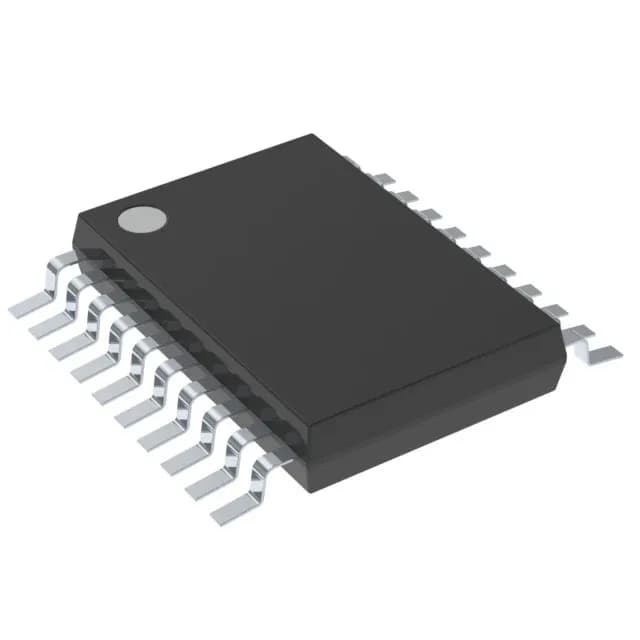
The MCU comes in a 20-TSSOP package (4.40 mm body width, 0.65 mm pitch), designated as supplier device package 20-TSSOP. It is a surface-mount device intended for reflow soldering. The narrow body saves PCB area compared to a 20-SOIC, but the fine pitch calls for a controlled solder-paste stencil and a reflow profile consistent with JEDEC MSL level (typically MSL 3 — verify on the reel label; if the moisture barrier bag has been open longer than the floor life, a bake at 125°C for 24 hours is required before reflow).