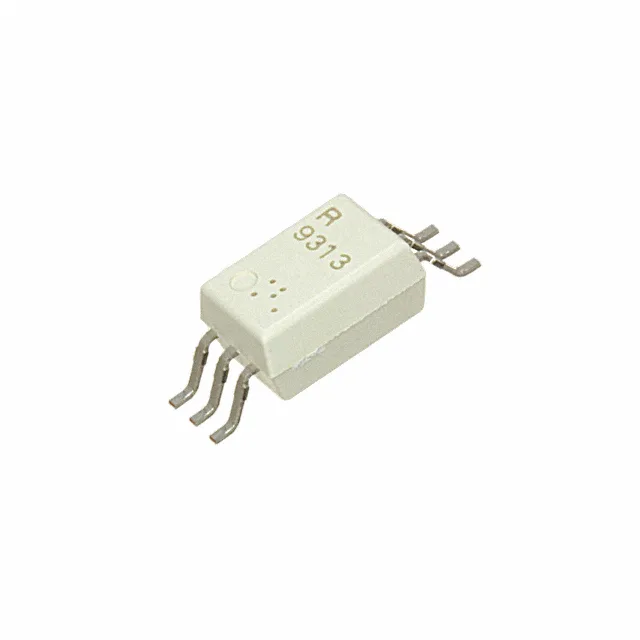
The PS9324L-E3-AX: The PS9324L--AX: The Renesas PS9324L--AX is a single-channel digital optocoupler with an open-collector output, designed for isolating logic-level signals across a 5000Vrms barrier. It runs at 10Mbps, which is fast enough for most industrial fieldbus interfaces like Profibus or DeviceNet, and the open-collector stage lets you pull up to whatever supply voltage your downstream logic needs — 5V, 3.3V, or even 2.7V on the low end. The 6-SOIC package with a 6.80mm body width gives you decent creepage for the isolation rating, and the operating range from -40°C to 110°C covers both outdoor telecom cabinets and factory-floor enclosures without active cooling.
Open-collector output — pull-up resistor and logic-level choices
Because the output is open collector, you need an external pull-up resistor to Vcc. The 25 mA per-channel output current means you can sink a standard TTL or CMOS load directly, but the pull-up value sets the rise time — faster edges need a lower resistor, which costs more current. At 10Mbps, a 1kΩ pull-up to 5V gives you about 5 ns rise time, which keeps the eye open. The supply range of 2.7V to 5.5V means it works with 3.3V and 5V logic families without a level shifter, as long as you match the pull-up rail.
Isolation and transient immunity for motor-drive environments
The 5000Vrms isolation is the spec that qualifies this part for reinforced insulation in mains-connected equipment — think motor drives, inverters, and industrial power supplies. The common-mode transient immunity of 15kV/µs is the number that matters when you're isolating a microcontroller from a half-bridge driver: fast-switching IGBTs can slam 600V across the isolation barrier in a few nanoseconds, and if the optocoupler can't reject that edge, you get a glitch on the data line. 15kV/µs is adequate for most IGBT gate-drive applications up to about 20 kHz switching frequency; for faster SiC or GaN stages, you'd want a part with 50kV/µs or more.
It is ROHS3 compliant, which keeps it clear of the RoHS exemption expirations that hit some older optocouplers.