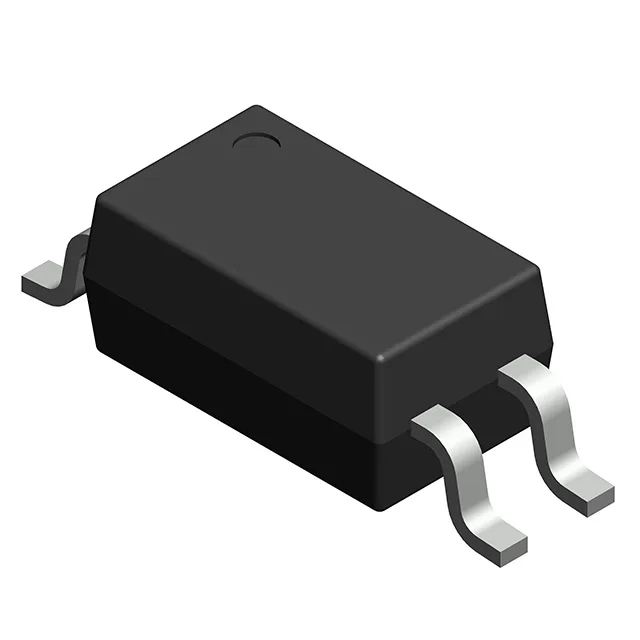
Active NEPOC Darlington opto — 2500Vrms isolation, 1500% CTR
The PS2733-1-V-F3-A is a single-channel DC-input optoisolator from Renesas's NEPOC series, featuring a Darlington transistor output. It provides 2500Vrms of galvanic isolation with a minimum current transfer ratio of 1500% at just 1 mA forward current — meaning a very low input drive can switch a much higher load on the output side. The output is rated for up to 350V and 150mA, making it suitable for driving relays, solenoids, or high-side switches directly from a logic-level signal without an external driver transistor. The part is packaged in a 4-SMD Gull Wing (4-SOP) footprint for automated surface-mount assembly, and it operates over a -55°C to 100°C temperature range, covering most industrial and some automotive under-hood environments.
The Darlington output gives you a lot of current gain — the CTR spec of 1500% minimum means the output can sink 15 times the input LED current. But the trade-off is a higher saturation voltage: 1V max at the rated output current. If your load needs to swing close to the supply rail (say, driving a 5V relay from a 5V rail), that 1V drop means the load sees about 4V, which is fine for most 5V relays but worth checking against the relay's pick-up voltage. For lower-drop applications, a transistor-output opto like the PS2801C-4-V-A (300mV Vce sat) might be a better fit, though you lose the high CTR.
Switching speed: 100µs rise/fall — not for fast data
Rise and fall times are both 100µs typical. That is fine for DC level sensing, status feedback, relay or contactor drive, or any application where the signal changes at human timescales. It will not work for high-speed PWM (above a few hundred Hz) or for isolating a data bus — for that you would want a digital isolator or a high-speed optocoupler with sub-microsecond switching.
Package and field-swap reality
The 4-SMD Gull Wing package is small and surface-mount, so swapping it in the field without a hot-air station is tricky — you will need a soldering iron with a fine tip and some patience. The pin-1 marking is usually a dot or a chamfer on the package body; orientation is standard for a 4-pin SOP. If you are doing a board-level repair on site, bring a hot-air rework station or plan to replace the whole board. For socketed or through-hole alternatives, this is not the part.