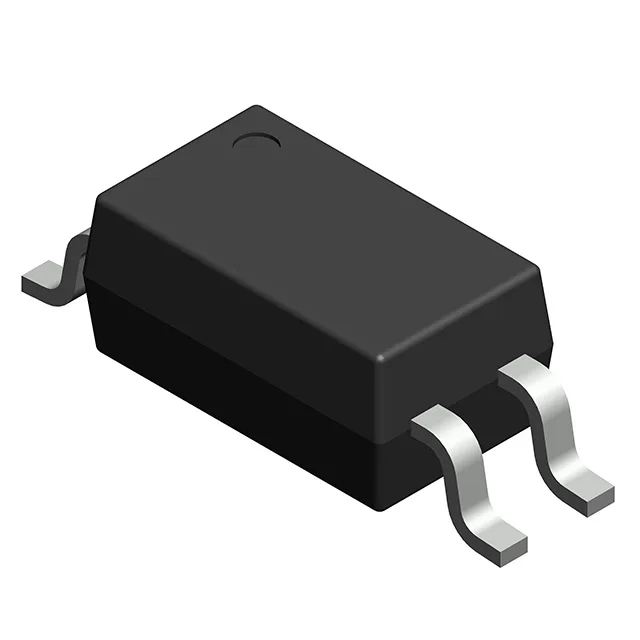
Darlington output saves a transistor stage
The Renesas PS2702-1-V-F3-A is a single-channel NEPOC optoisolator that pairs a DC-input LED with a Darlington phototransistor output in a 4-SMD gull-wing package. The Darlington configuration gives you a minimum current transfer ratio of 200% at just 1 mA forward current, so a low-side microcontroller GPIO can switch the output without an external driver transistor. Output is rated for 200 mA continuous and 40 V across the collector-emitter, which covers small relays, solenoid valves, and PLC input modules directly. Isolation is 3750Vrms — enough for reinforced insulation in mains-connected industrial controls.
That is fine for 50/60 Hz AC sensing, relay coil drive, or status feedback where the update rate is tens of milliseconds. It will not pass a 10 kHz PWM cleanly — for that you want a transistor-output opto with microsecond edges. The 200 µs edges also mean the output slew rate is low enough to skip snubber networks on short PCB traces.
That covers outdoor telecom cabinets, factory-floor enclosures, and engine-bay-adjacent electronics, though it does not carry AEC-Q101 automotive qualification. The 4-SOP body with gull-wing leads is a standard footprint for reflow assembly; the 4-SMD case is the same outline as many other NEPOC single-channel isolators, so a layout swap between siblings is usually a BOM-line change, not a board spin.