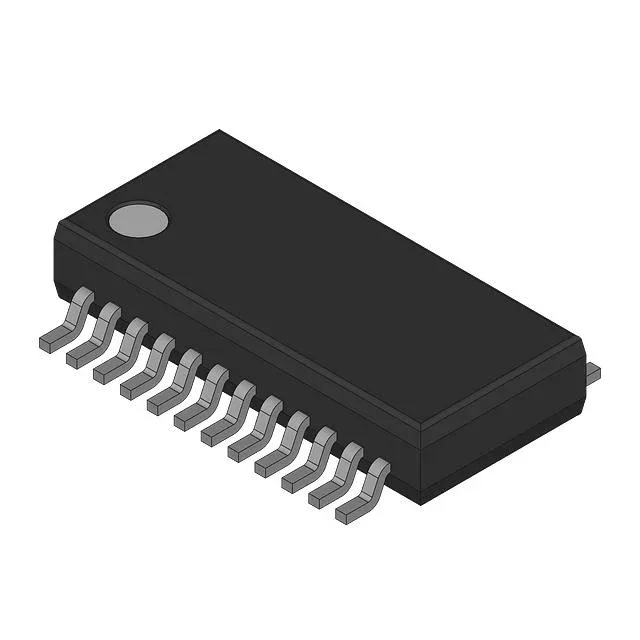
The IDT74FCT2543TQ from IDT (now part of Renesas) is an octal latched transceiver — a bidirectional bus interface that stores data on the input side and drives it onto the bus with 3-state outputs. It is a non-inverting device, meaning the logic level at the output matches the latched input. This part is designed for 5V backplanes and memory buses where you need to isolate or buffer data lines while holding a word for a clock cycle.
The supply range is 4.75V to 5.25V, which is a tight 5V ±5% window. That rules out 3.3V-only systems — this part goes into legacy 5V logic or mixed-voltage designs where a separate 5V rail is available. It is not a military-grade part, but it handles the typical extended-temperature industrial bay.
These are closely related footprints — the QSOP is the narrower version (typically 3.9mm vs 5.3mm body width for standard SSOP). Both are surface-mount, so the PCB layout should be checked against the specific package variant you receive. The 24-pin count is standard for octal transceivers, and the 0.0256" (0.65mm) pitch is common enough that the footprint is not exotic.
The output high and low current ratings are 15mA and 12mA respectively. That is modest drive — enough to drive a few TTL loads or a short backplane trace, but not a high-capacitance bus. If your bus has many loads or long stubs, you may need a buffer or a higher-drive transceiver. The 3-state outputs let multiple devices share the same bus lines, which is the normal use case for a bidirectional transceiver.
Lifecycle and compliance — what to know before ordering
If your BOM requires RoHS compliance, you will need an exemption or a lead-free alternate. For legacy designs that already use tin-lead solder, this is not an issue.