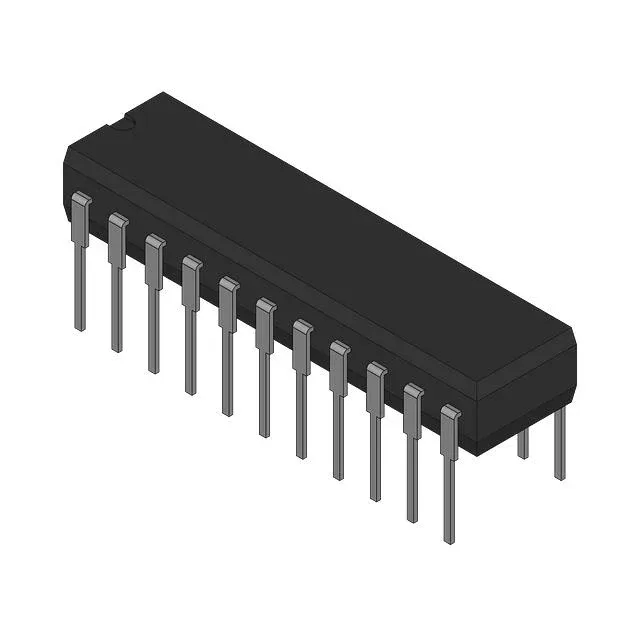
1Kbit parallel SRAM in a ceramic DIP — what you're looking at
The HM1-6551/883 is a 1Kbit (organized 256 x 4) parallel SRAM from the 883-series, built in a hermetic 22-lead ceramic DIP (22CDIP) for through-hole mounting. It runs on a single 4.5V supply and delivers a 300 ns access time with a 400 ns write cycle. The memory is volatile — data persists only while power is applied — and uses a straightforward parallel interface with no clock or multiplexing.
For a controller running at 4.5V, this is a relaxed timing window — you'll have no trouble interfacing with a slow 8-bit microcontroller or a legacy 6800/8085-style bus. But if you're trying to hang this on a fast 16-bit or 32-bit processor that expects sub-100 ns SRAM, you'll need wait states or a slower clock divider. The 400 ns write cycle time is similarly relaxed: the write pulse must be held long enough for the internal bit lines to settle. For a BOM engineer, this part fits designs where bus speed is not the priority — think telemetry data logging at a few hundred kHz, configuration register storage, or a small FIFO buffer in a system that already runs at a few MHz.
This is not a commercial or industrial part that happens to survive cold — it's screened and specified to guarantee operation across that entire span. The 883 suffix in the part number indicates it was originally processed to MIL-STD-883 requirements, which means lot-level testing, temperature cycling, burn-in, and hermeticity verification. For a procurement desk, this is the part you spec when the board goes into an engine bay, a satellite sun-synchronous orbit, or a radar pod that freezes at altitude. The ceramic DIP package (22CDIP) is hermetic — it won't absorb moisture or outgas in vacuum, unlike plastic packages. That matters for sealed assemblies and long-life missions where conformal coating alone isn't enough.
Package reality — 22CDIP and how it sits on the board
The 22-lead ceramic DIP (22CDIP) is a through-hole package with leads on 0.3-inch row spacing, standard 0.1-inch pin pitch. It's a dual-in-line body, so it plugs into a 22-pin socket or solders into plated through-holes. For rework: this package is a dream compared to a QFN or BGA. You can desolder it with a vacuum desoldering station or even careful hot-air from the bottom side without lifting pads. The ceramic body handles the heat — it won't melt or delaminate like plastic. The through-hole mounting means it's mechanically robust: it won't shake loose in a high-vibration environment the way a large PLCC might. Just make sure your board has the 0.3-inch row spacing — this is not a skinny 0.3-inch DIP; it's the wider 0.6-inch row spacing typical of 24-pin and larger DIPs.
This is not an obsolete or NRND part that requires a last-time-buy calculation. For a design engineer, that means you can spec it into a new military or aerospace program without worrying about a mid-production EOL notice. No lead-time number is published here, but the active status means the supply chain is stable — no urgent broker scramble needed.