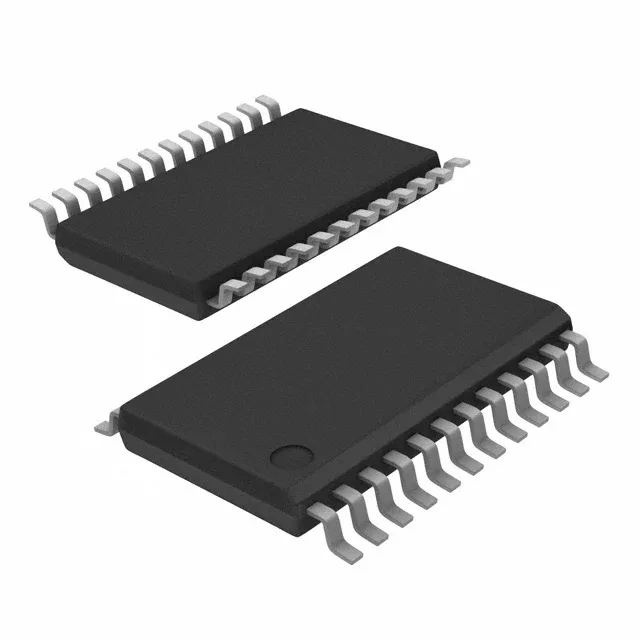
8:1 differential multiplexer for high-frequency clock routing
The Renesas 854S058AGILF is an 8:1 differential multiplexer designed for selecting one of eight differential clock or data inputs and routing it to a single LVDS output. It accepts LVDS, LVPECL, and SSTL input levels, making it a flexible building block in systems that must switch between multiple clock sources without external level translation. The part is rated for a maximum frequency of 2.5 GHz, which covers the vast majority of high-speed serial links, SerDes reference clocks, and FPGA/ASIC reference inputs used in telecom and datacom equipment. The 24-TSSOP package (4.40 mm width) keeps the board footprint compact, and the supply range of 3.135 V to 3.465 V aligns with standard 3.3 V power rails.
2.5 GHz bandwidth — what it means for signal integrity
The 2.5 GHz maximum frequency is the key parametric that determines whether this multiplexer can pass a given clock or data stream without excessive jitter or amplitude degradation. For a 2.5 Gbps NRZ data stream, the fundamental frequency is 1.25 GHz, so the part has roughly one octave of margin. For a 10 Gbps SerDes reference clock at 156.25 MHz, the margin is enormous. The differential input and output (Yes/Yes per the spec) mean the part preserves common-mode rejection and noise immunity that single-ended routing would lose — important when the trace runs across a noisy board or through a backplane.
Input flexibility: LVDS, LVPECL, SSTL
The ability to accept LVDS, LVPECL, and SSTL inputs on the same die means the 854S058AGILF can sit at the junction of multiple clock domains without needing separate input buffers or AC-coupling caps for each standard (though DC-coupling levels must still respect the common-mode ranges). This is a practical advantage in a system that mixes, say, an LVDS oscillator for the main reference and an LVPECL clock from a SerDes device — one mux handles both. The output is LVDS only, so downstream logic must be LVDS-compatible.