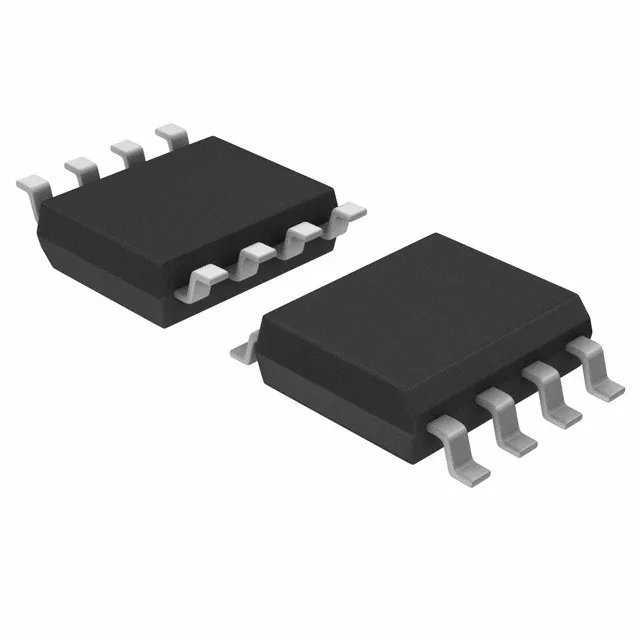
853S011BMILF — 2.5 GHz 1:2 fanout buffer in 8-SOIC
The Renesas 853S011BMILF is a 1:2 differential fanout buffer. It accepts CML, LVDS, LVPECL, or SSTL input signals and delivers two ECL or LVPECL outputs, all differential, with a maximum frequency of 2.5 GHz. The single supply operates from 2.375 V to 3.8 V.
Signal compatibility — input and output types
The input stage accepts four common differential standards: CML, LVDS, LVPECL, and SSTL. That covers most high-speed clock sources from oscillators, SerDes, and FPGA transceivers. The outputs are ECL or LVPECL levels, which are the standard for driving high-speed ADC/DAC clock inputs and FPGA clock-capable pins. Both input and output paths are fully differential, giving common-mode rejection on long board traces or cables. The 1:2 ratio means one input fans out to two output copies with matched skew.
The 2.5 GHz maximum frequency covers the fundamental clock rates for 10 GbE, 12G-SDI, and high-speed data converter sampling clocks. At these frequencies, the 8-SOIC package's parasitics matter — the short leadframe and small body keep the signal path clean. For a 156.25 MHz or 312.5 MHz reference, this part has plenty of margin; the jitter contribution is dominated by the input source, not the buffer.
For dual-sourcing or a higher fanout option, the 8SLVP1104ANLGI provides a 1:4 LVPECL fanout in a similar package, though it operates at 2 GHz maximum and requires a 3.135 V supply.