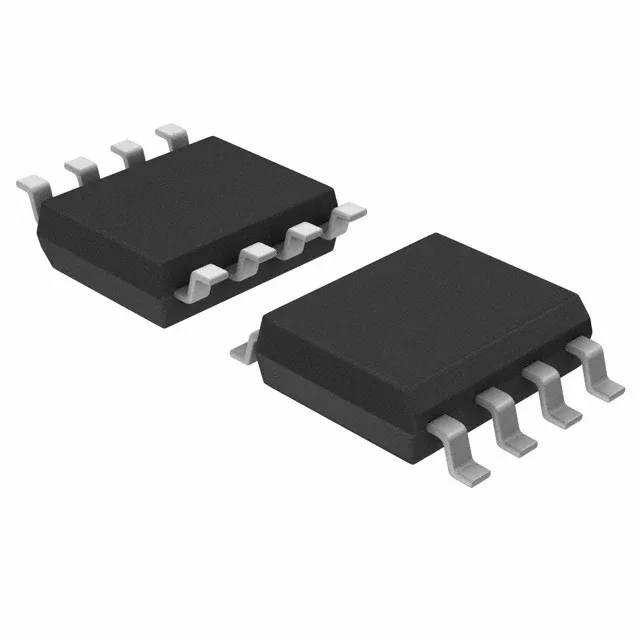
The Renesas 551MLFT is a single-circuit, 1:4 fanout buffer from the ClockBlocks™ family, designed to distribute a single CMOS clock input to four CMOS outputs with minimal skew. It handles clock frequencies up to 160 MHz and operates from a 3V to 5.5V supply, making it a straightforward fit for 3.3V or 5V logic rails in commercial-temperature (0°C to 70°C) equipment such as networking gear, base-station control cards, test instruments, and office appliances where a clean, buffered clock tree is needed without differential signalling.
The 1:4 input-to-output ratio means one incoming CMOS clock fans out to four identical CMOS outputs, each capable of driving the full 160 MHz rate. For a typical 50 MHz or 100 MHz system clock, this part provides enough margin to keep the output edges clean. The non-differential I/O (CMOS in, CMOS out) simplifies the board — no termination resistors or AC-coupling caps needed, which saves BOM cost and board area compared to LVPECL or LVDS fanout buffers. The 3V to 5.5V supply range directly matches common logic rails, so no extra regulator is required when the system already runs at 3.3V or 5V.
The ROHS3 compliance also aligns with current environmental regulations for most markets.
Package and storage — 8-SOIC, MSL considerations
Housed in an 8-SOIC package (0.154" body width, 3.90 mm), the 551MLFT is a standard surface-mount footprint that reflows easily with typical lead-free profiles. The Tape & Reel and Cut Tape options cover both prototyping and volume pick-and-place. As with most SOIC parts, moisture sensitivity is typically MSL 1 or 2 — store the reels in a dry environment if the original moisture-barrier bag is opened, but no special bake is required for most assembly flows.