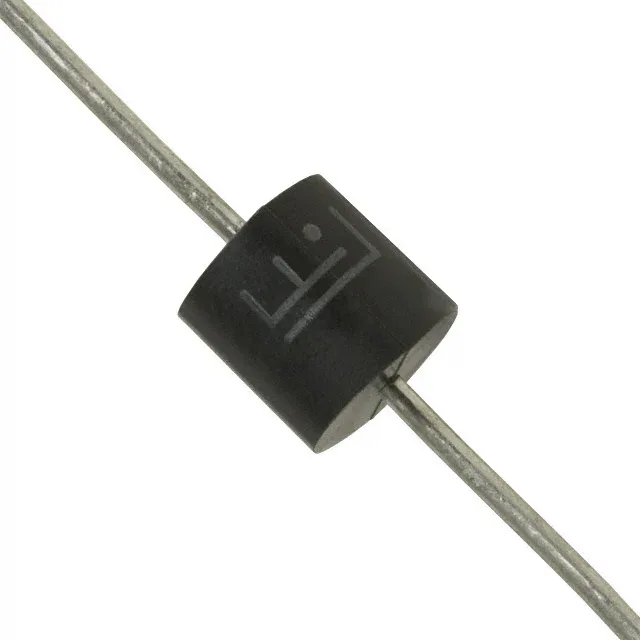
What a 5 kW peak-pulse TVS diode does in a circuit
The 5KP10A_R2_00001: That energy margin is what distinguishes this class from lower-rated TVS diodes and makes it suited for industrial and equipment-level protection where the source impedance of the surge path is low enough to push real current into the clamping element.
Surge-handling and clamping voltage
At the 294A peak pulse current the part clamps to a maximum of 17V, with a minimum breakdown of 11.1V — the clamping voltage minus the breakdown voltage gives the overvoltage headroom that the protected load sees during the event. For a 10V rail this means roughly 7V of differential above the standoff before the suppressor turns on, which is the figure that determines whether downstream semiconductor gates survive the event. Shorter pulses (8/20 µs, common in AC distribution fault current) deliver higher peak current at the same energy because the joule heating has less time to raise the junction temperature, so a 5 kW-rated part will typically survive higher instantaneous peak currents in that waveform regime than the 10/1000 spec implies.
Thermal and package fit for panel integration
The P600 axial through-hole package accepts hand insertion or wave solder and the lead pitch is compatible with standard 0.1-inch pitch board layouts. For repair-bench or prototype quantities the cut-tape option avoids ordering a full reel; for production the tape-and-reel option supports automated insertion equipment standard in through-hole assembly lines.
The part is quoted to order against BOM quantities through independent distribution. Lead time and unit pricing are confirmed at RFQ. Confirm the full BOM line quantity and the required packaging cut before committing — TR and CT have different minimum order increments and different shelf-life handling profiles.