What the clamping chain means for board-level protection
The 1.5SMCJ60A_R1_00001: The 60V reverse standoff is the working voltage — the TVS stays off and draws only leakage current while the rail sits below this level. The 1.46× ratio between clamping ceiling and standoff means the downstream load sees a brief overvoltage excursion before the TVS reaches its limiting region — that gap is the surge let-through the downstream circuitry must survive unaided. For longer-duration or higher-energy events the clamping voltage climbs along its V-I characteristic, so the 96.8V ceiling applies only at this test current — the real clamping voltage in a severe surge is higher than the datasheet number.
1500W peak pulse and thermal margin
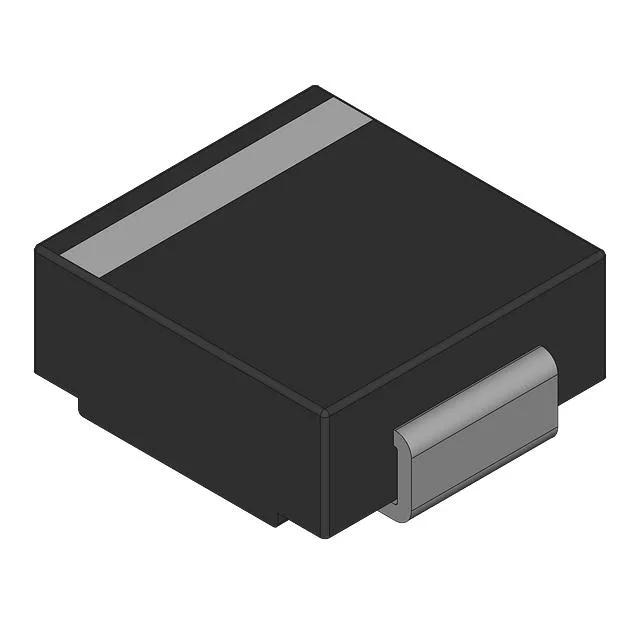
The 1500W peak pulse rating defines the surge energy the part survives once — it is not a continuous power rating. At continuous DC conditions the part handles much less — the datasheet derating curve governs, not the 1500W headline. DO-214AB (SMC) package with a thermal pad on the bottom side relies on board copper for heat sinking. A proper landing pad — typically the cathode pad tied to a large copper plane — is required to achieve the rated peak pulse capability. Without adequate copper area the junction temperature rise during a surge exceeds the 150°C limit and the part fails short.
Unidirectional, general-purpose protection
Unidirectional polarity means it clamps positive transients on a DC rail — it does not protect against negative surges. For AC lines or dual-polarity rails a bidirectional TVS is required. The "Power Line Protection: No" flag on this listing reflects that the 1.5SMCJ series is not UL 1449 recognized as a component-level surge protective device (SPD) — it is a board-level clamping component, not a service entrance device. Surface mount in tape-and-reel and cut-tape packaging suits high-volume assembly; the DO-214AB body fits standard reflow profiles. The series covers a wide standoff range from roughly 5V up through 440V in the 1.5SMCJ family — this part's 60V standoff positions it for 48V bus, 24V industrial control, and 12V automotive sub-circuits.