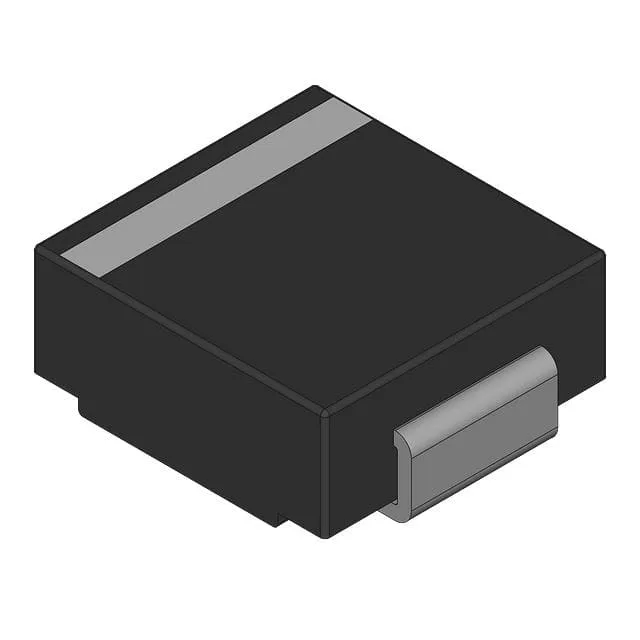
Bidirectional TVS — what the 51 V rail rating means
The 1.5SMCJ51CA_R1_00001: The 51 V reverse standoff is the normal operating rail — the diode stays off and invisible to the circuit up to that level. A downstream component must survive 82.4 V during a surge event, not 51 V — that distinction governs the clamping margin your circuit requires. The CA suffix marks this as bidirectional — it handles both polarities without a polarity marker, making it the right choice for AC signal lines, floating rails, and any circuit where the transient can swing both directions. A unidirectional TVS would clamp asymmetrically on an AC waveform or misfire on a negative-going surge.
The 18.2 A peak pulse current is the companion figure at that waveform. If your surge source delivers a different energy profile — faster rise, longer tail — the effective clamping voltage and peak current will shift. The datasheet curves for your specific waveform are what size the part, not the 1500 W headline alone.
Above 25 °C the derating curve applies — the peak pulse capability drops as the junction runs hotter, so in a hot environment the 1.5 kW rating buys less margin than the datasheet number implies at room temperature.