What the standoff, breakdown, and clamping specs mean
The 1.5SMCJ43A-AU_R1_000A1: The reverse standoff of 43 V (typ) is the working rail the protected circuit runs at — above it the diode begins to conduct. The breakdown minimum of 47.8 V is the threshold where avalanche kicks in and the TVS begins clamping.
This is the standard IEC 61000-4-5 waveform for evaluating protection on automotive and industrial power rails — the 21.6 A peak current at the clamping voltage follows directly from 1500 W ÷ 69.4 V. A higher clamping voltage means more stress passes to the load; the 69.4 V ceiling at this current is tight enough for most 40 V automotive rails.
AEC-Q101 automotive grade and where it matters
AEC-Q101 qualification means the die and package have passed the automotive stress tests — temperature cycling, humidity bias, and surge-life screening that a commercial-grade TVS is not required to survive. If the end application is automotive electronics, ADAS, or any safety-adjacent system, AEC-Q101 is a hard gate — a commercial-grade Zener does not meet that bar.
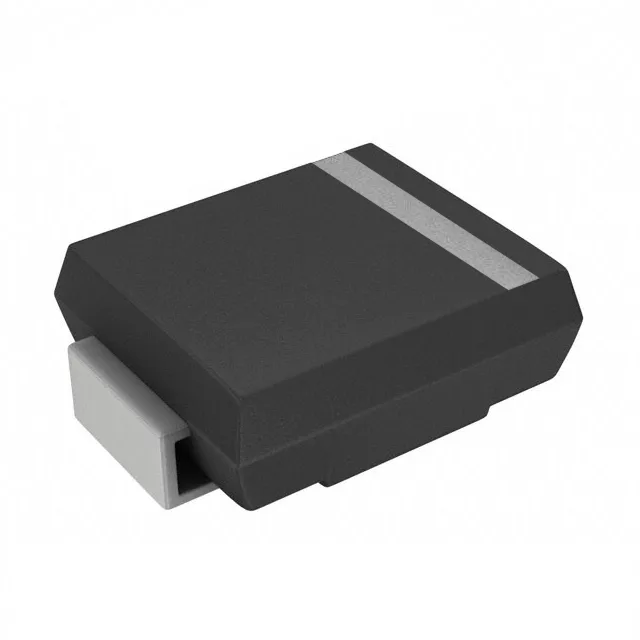
DO-214AB SMC footprint and reel packaging
The DO-214AB (SMC) is a dominant surface-mount package for TVS diodes in power applications — the cathode tab directly bonds to the copper pad on the PCB, giving the layout engineer a defined thermal path to the board plane. Supplied on tape-and-reel; the component engineer should confirm the MSL rating before prolonged floor exposure. The unidirectional single-channel topology means this protects one polarity only — a positive-going transient on the protected rail.