What 36 V standoff and 1.5 kW peak mean for automotive transient protection
The 1.5SMCJ36A-AU_R1_000A1: The minimum breakdown of 40 V sits above the 36 V standoff, so the device remains off and draws negligible leakage at the working rail; it snaps into avalanche conduction only when a transient exceeds that threshold.
Belongs to the Panjit Automotive AEC-Q101 series — the discrete-semiconductor counterpart to AEC-Q100 for ICs. AEC-Q101 screens for humidity, temperature cycling, and surge stress consistent with under-hood and chassis-domain deployments where the TVS guards ECU inputs, CAN/LIN transceivers, or sensor rails. Junction temperature rated to 150 °C with a floor of -55 °C — the wide window accommodates engine-bay ambient swings and cold-soak startup without derating the clamping performance. The 150 °C ceiling also allows margin against thermal runaway in adjacent PCB hotspots. This part is designated as automotive-applications focused and does not carry a power-line protection rating — it is not intended for direct AC line clamping or mains-frequency surge diversion; it guards low-voltage signal and power rails inside the ECU harness.
DO-214AB SMC footprint and SMT assembly considerations
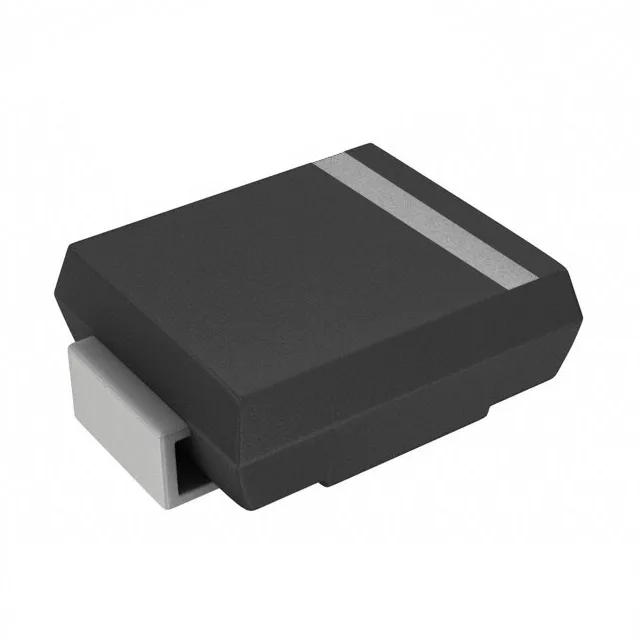
Supplied in the DO-214AB (SMC) package — a common automotive SM footprint with a wide cathode tab that conducts heat from the junction to the PCB copper. The supplier device package designation is SMC (DO-214AB), confirming the exact land pattern and pad layout for the layout. Available on tape-and-reel (TR) for high-volume SMT placement and on cut-tape (CT) for prototype quantities — the same body style, no difference in electrical or thermal ratings between pack types.
BOM engineers working from the AEC-Q101 series should confirm at RFQ whether a second-source from another AEC-Q101-qualified supplier is acceptable for new design qualifications, or whether Panjit is the sole qualified source.