What the 33V standoff voltage means for rail protection
The 1.5SMCJ33A-AU_R1_000A1: The 33V reverse standoff (typ) is the working voltage below which the TVS stays off and presents only a high-impedance leak to the protected rail — the line runs clean at 33V and below with no clamping action. The minimum breakdown of 36.7V sits above the standoff, so the device does not activate on normal operation. These two numbers bracket the protected window: design the rail at or below 33V nominal, and the TVS activates only when a surge pushes the node above 36.7V. When a transient does arrive, the clamping voltage of 53.3V at the 28.1A peak pulse (10/1000 µs waveform) is the figure that limits what the downstream IC sees — a 24V rail clamped to 53.3V still protects most automotive CAN/LIN PHY inputs and low-voltage regulator front ends without overdriving them into a second failure mode.
Peak pulse power and how it maps to real-world transients
Sizing a TVS for a faster waveform at the same energy costs you effective clamping headroom, so confirm the threat profile before committing this part to a 8/20 µs application.
AEC-Q101 is the automotive discrete-semiconductor stress qualification — it subjects the part to temperature cycling, humidity bias, and surge testing at the device level, confirming it survives the thermal and electrical excursions of a module deployed in the engine bay or chassis domain without going to a full system-level qualification.
Package and automotive production status
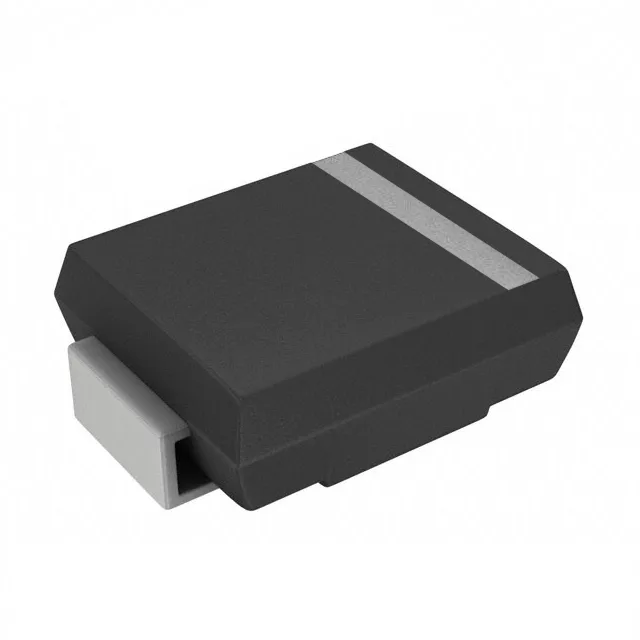
DO-214AB (SMC) is the standard automotive TVS package — wide-body SMC with the cathode band marking for polarity orientation during assembly. Surface-mount termination handles standard reflow profiles; the tape-and-reel and cut-tape packaging options cover both high-volume SMT line runs and low-volume rework or prototyping. Confirm full reel quantities and date-code fresh-out requirements with your distributor before committing to a volume BOM, particularly if the assembly house specifies automotive-grade material review.