What the clamping specs mean for protection design
The 1.5SMCJ28AS_R1_00001: 28V reverse standoff is the working voltage — the TVS stays off and draws only leakage current while the rail sits below this level. Above 31.1V the Zener junction breaks over and the diode clamps, pinning the protected node at 45.4V max even as the peak pulse current reaches 33A. The 1500W peak pulse rating at this same waveform sets the clamping ceiling, so the part handles a real transient without going into thermal runaway on the board.
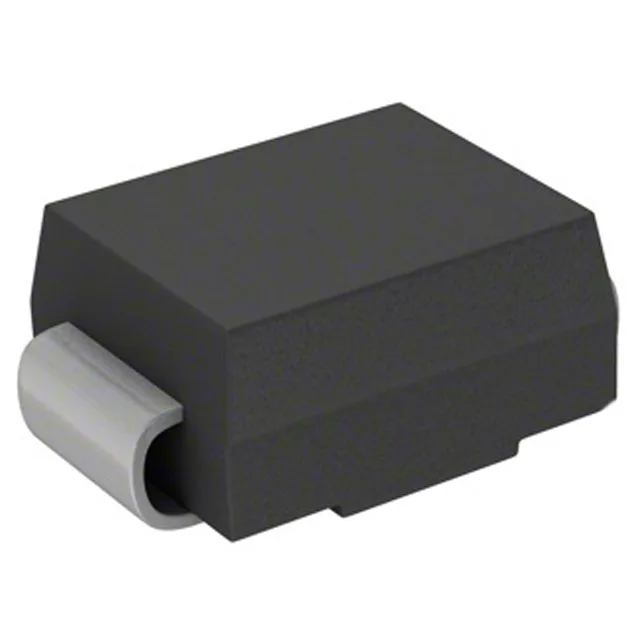
DO-214AB (SMC) is a standard SMT body for TVS diodes — the cathoded-band marking tells you polarity at a glance before the board goes through reflow. Surface-mount termination supports pick-and-place assembly in volume without clinch leads or hand soldering — useful for a protection device that often ends up near the supply entry or connector on the PCB. Tape-and-reel and cut-tape options are both listed — reel format suits high-volume SMT lines, cut tape works for small-batch rework or panelization runs.
Where a unidirectional TVS in this class is deployed
Unidirectional 1.5SMCJ TVS diodes clamp positive transients relative to ground — the standard topology for DC supply rails, signal lines, and control buses that only need one-polarity protection. The 28V standoff rating fits 24V industrial rails with adequate margin (24V nominal → ~1.15× standoff headroom).