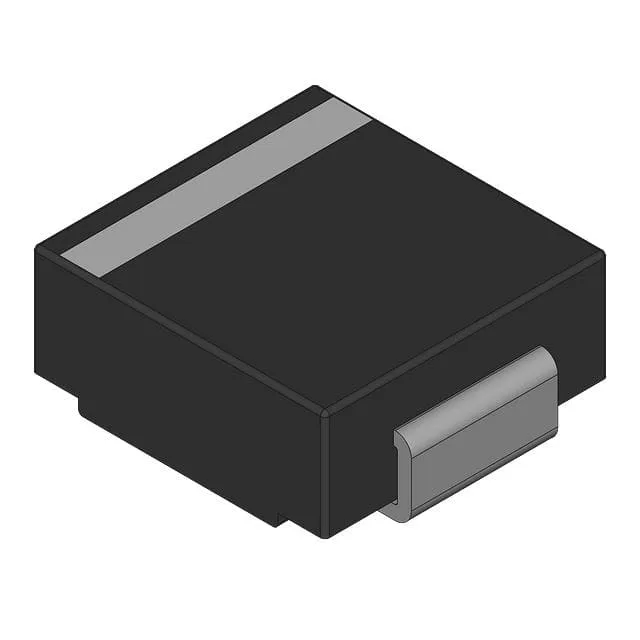
Unidirectional Zener TVS in the 1.5SMCJ series
The 1.5SMCJ13A_R1_00001: As a unidirectional TVS, it clamps a positive-going overvoltage spike to the defined clamping level while leaving the normal signal path undisturbed — making it the right choice for protecting a DC rail against lightning-induced transients and switching surges in general-purpose applications.
What 13V standoff and 21.5V clamping mean for the protected rail
The reverse standoff voltage is 13V typ — below this the diode presents a high impedance and the protected circuit sees no effect. The gap between 13V standoff and 14.4V minimum breakdown gives the circuit roughly 1.4V of headroom before the clamp activates, so normal operating transients below standoff are silently passed.
1.5kW peak pulse — the rating that survives the surge
The 69.7A peak pulse current at that waveform is the figure that determines whether the clamping voltage holds low enough to protect downstream semiconductors. On a 13V rail, a 21.5V clamping level gives a protection margin of 8.5V during the event — enough for most logic-level and MOSFET gate-drive circuits operating below 12V.
Junction temperature and deployment environment
This temperature band is wider than commercial or industrial consumer-grade parts and makes the part suitable for instrumentation and infrastructure that sees wide ambient swings.
The part is listed as Active in production. The DO-214AB SMC package is the most widely second-sourced TVS package in the industry, so alternative sources within the same pinout are common — confirm the exact breakdown and clamping specs at RFQ since the voltage code (13) sets the standoff and the clamp is derived from it, but the breakdown minimum and peak pulse current should be matched, not assumed identical across manufacturers.