TVS selection — what the standoff and clamping ratings mean
The 1.5SMCJ120CA_R1_00001: The 120V standoff is the reverse-bias voltage the diode blocks in normal operation — the protected rail sits below this level and the TVS stays off. Breakdown starts at 133V minimum, which sets the threshold where the device first begins conducting. The clamping voltage of 193V is the maximum the downstream circuitry sees when the full 7.9A peak pulse (10/1000 µs waveform) hits — that number is the clamp ceiling, not a target. A single bidirectional channel protects a single line without needing two separate unidirectional devices. Power line protection is listed as No — this part is not intended for direct AC power-line protection at 220/240 V; it is suited for DC rail clamping and board-level transient suppression at the 120 V standoff level.
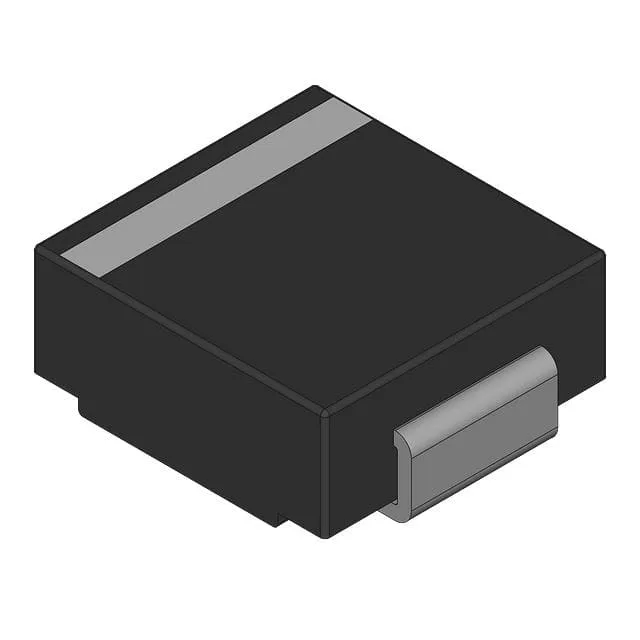
DO-214AB SMC package and board integration
The SMC (DO-214AB) package is the mid-size surface-mount TVS footprint — larger than the SMA (DO-214AC) and smaller than the SMB (DO-214AA). The cathode band marks the polarity on the unidirectional variant; for this bidirectional part the band orientation still follows the tape orientation. Land pattern follows the JEDEC DO-214AB outline. Thermal relief on the pad and adequate copper pour around the termination tabs help the clamping event dissipate without pushing the junction temperature past the 150°C ceiling.