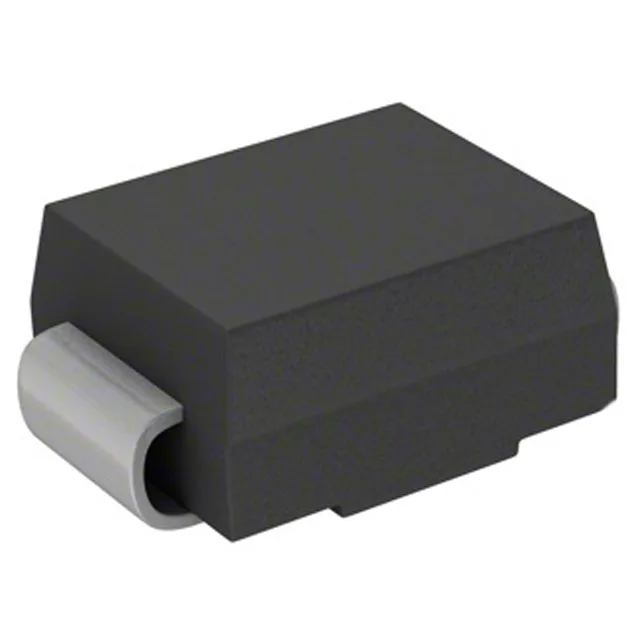
What the 1.5SMC75CA-AU_R1_000A1 protects and why the ratings matter
Rated 1500 W peak pulse power at 10/1000 µs — the 1.5 kW ceiling is the energy the diode can absorb in a single automotive-style transient pulse without degradation. Reverse standoff of 64.1 V typ is the working voltage below which the TVS stays off and draws only leakage current; the downstream rail can sit at this nominal level with the diode monitoring passively. Breakdown minimum is 71.3 V — when the line exceeds this, the Zener avalanche fires and the clamping path activates.
Automotive qualification and thermal margin
AEC-Q101 qualification is the discrete-semiconductor automotive stress standard — it covers surge testing, humidity bias, temperature cycling, and mechanical shock in the sequence defined by the AEC council, giving the part a fit-for-automotive declaration that an industrial-grade TVS cannot claim. Operating junction temperature extends to 150 °C, meaning the part tolerates reverse-bias self-heating and ambient spikes well above the 125 °C ceiling typical of standard automotive-grade parts — important in engine-compartment-adjacent modules where TJ can run hot. The DO-214AB (SMC) package is the mid-power TVS footprint — the wide body and exposed cathode tab give lower thermal resistance to the board compared to the smaller SMA package, which is why this series sits above the 1.5SMC6xx series in the power stack.