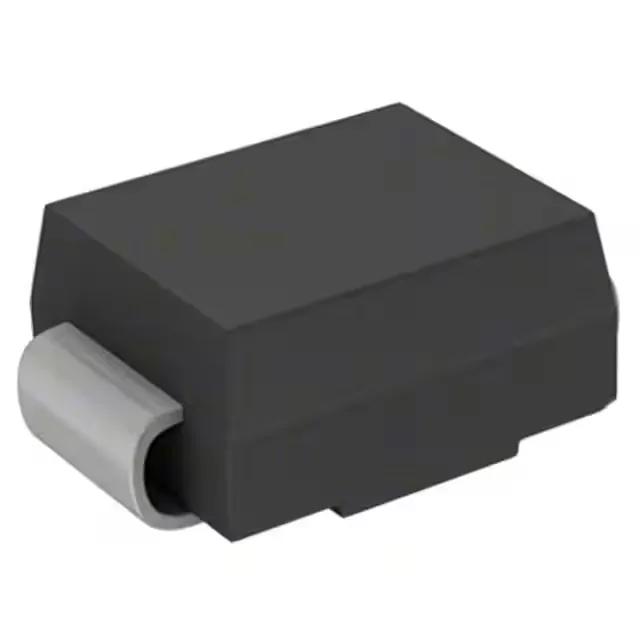
The 1.5SMC36CA-AU_R1_000A1: No minimum order threshold beyond the standard reel increments.
AEC-Q101 automotive qualification — the under-hood temperature band
The 1.5SMC-AU series is qualified to AEC-Q101, the automotive discrete semiconductor stress test standard. An engine-bay ECU or transmission controller that sees 125°C ambient still has 25°C of margin before the junction limit. The Automotive application designation in the spec confirms it is intended for use in safety- and reliability-critical vehicle systems, not just a commercial-grade part with a wide temp range.
Clamping voltage and peak pulse power — what the downstream circuit sees
The 34.2 V minimum breakdown voltage is where the device starts to avalanche; the 49.9 V clamp is the voltage the downstream IC actually sees during the pulse. For a 36 V-rated component on the protected line, the 49.9 V clamp is within the typical 60 V abs-max of most automotive-grade transceivers and sensors, but a 40 V-rated part would need a lower-voltage TVS.
Bidirectional single-channel — one device, both polarities
With one bidirectional channel, this single DO-214AB package protects a signal line pair against positive and negative transients symmetrically. No need to back-to-back two unidirectional diodes — the Zener structure handles both polarities in one die. The 'CA' suffix in the order code indicates bidirectional; a unidirectional variant would carry a different suffix. The 'No power line protection' flag means this TVS is designed for signal and data lines, not for AC mains or high-energy power bus clamping. For a 24 V power rail in an automotive body controller, a higher-energy TVS or a polymer PTC would be the correct choice.
DO-214AB SMC package — hand-solderable with care
At 1.5 kW peak pulse, the junction temperature rise during the pulse is absorbed by the die itself — the package's thermal resistance to the PCB copper area matters more for repetitive pulsing than for single-event surges. For a maker or rework lab, the SMC package is hand-solderable with a fine-tip iron and flux — the body is large enough to hold with tweezers, and the two terminals are clearly defined. A hot-air station at 300°C for 10 seconds per joint is sufficient; no pre-bake required if the reel has been stored in a dry cabinet below 30°C/60% RH.