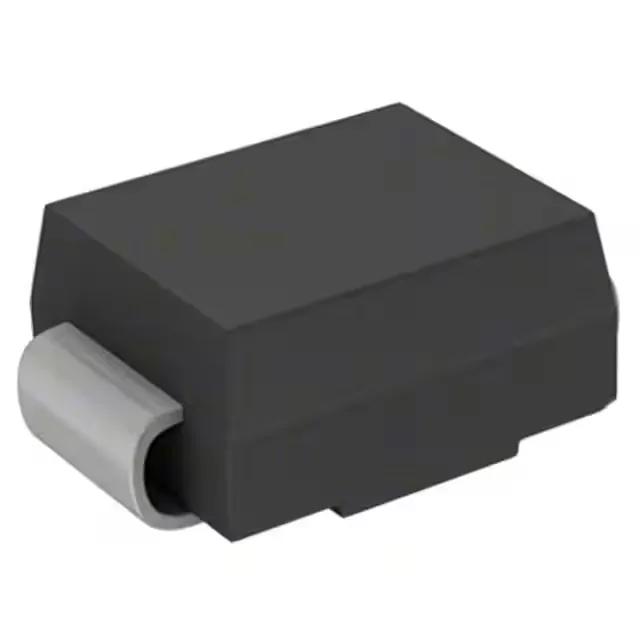
Automotive TVS for 12.8V rail clamping
The 1.5SMC15A-AU_R2_000A1 is a Zener-type TVS diode from Panjit's 1.5SMC-AU series, qualified to AEC-Q101 for automotive-grade reliability. The 12.8 V standoff sits comfortably above a nominal 12 V battery line, leaving margin for steady-state tolerances without clipping the supply.
AEC-Q101 and the 1500 W pulse budget
The -55°C to 150°C junction temperature range covers the under-hood and cabin thermal profiles — a 125°C ambient under the dash still leaves 25°C of margin before the junction limit. The 21.2 V clamp at 71 A is the voltage the downstream IC sees during a 10/1000 µs surge. For a 24 V load-dump event on a 12 V system, the TVS holds the rail below the 36 V abs-max of many automotive-rated buck converters and linear regulators. The 1500 W peak pulse rating is the energy it absorbs in that single-shot event — derate for repetitive pulses per the datasheet's pulse derating curve.
DO-214AB SMC footprint and reflow
Housed in the DO-214AB (SMC) package, the part is surface-mount with a standard JEDEC footprint. The large copper tab on the cathode side conducts heat into the PCB copper plane — the thermal resistance to ambient depends on the pad area and the number of vias under the tab. A 2 oz copper pour of at least 30 mm² keeps the junction temperature rise within budget during the 10/1000 µs pulse.