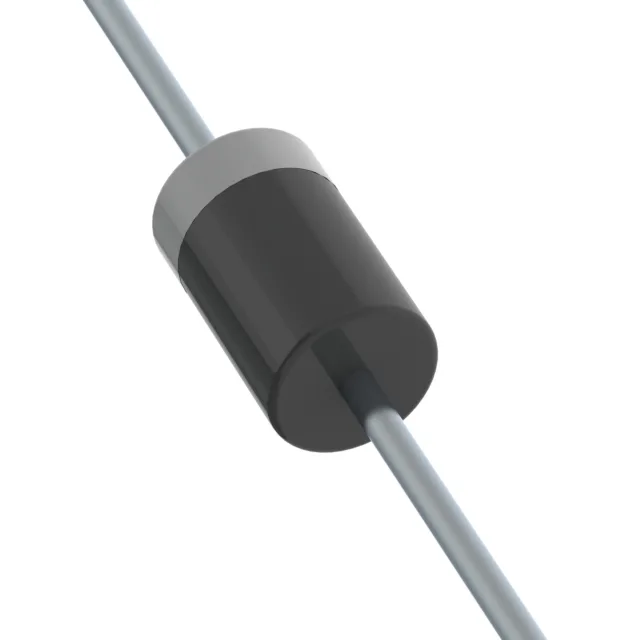
1.5kW surge clamp for 342V rails
The 1.5KE400A_R2_00001: Its unidirectional construction (1 channel) means it protects a single polarity line — the cathode band on the DO-201AE axial package marks the protected side, and the anode connects to ground. The 380V minimum breakdown voltage and 548V maximum clamping at 2.8A peak pulse current (10/1000µs waveform) define the protection window: the rail must stay below 342V during normal operation, and the TVS will begin conducting at 380V, holding the transient to 548V or less at the rated surge current.
Obsolete — sourcing through independent channels
Panjit has marked the 1.5KE400A_R2_00001 as obsolete. No board spin is required for a like-for-like swap.
What the clamping numbers mean for your rail
The 342V reverse standoff voltage is the maximum continuous DC voltage the TVS can withstand without significant leakage — a 300V nominal bus with 10% tolerance sits at 330V, which is below this threshold. The 380V minimum breakdown provides a 38V guard band before the device starts clamping, preventing nuisance triggering from normal switching transients. At the rated 2.8A peak pulse current (10/1000µs waveform), the clamping voltage reaches 548V maximum. This is the voltage the protected equipment must survive during the surge event. For a 342V rail, the 548V clamp represents a 60% overshoot — downstream components should be rated for at least 600V transient withstand to maintain margin. Derating applies at elevated temperatures — at 175°C junction, the power handling drops to approximately 25% of the 25°C rating, per the standard thermal derating curve for axial TVS diodes.