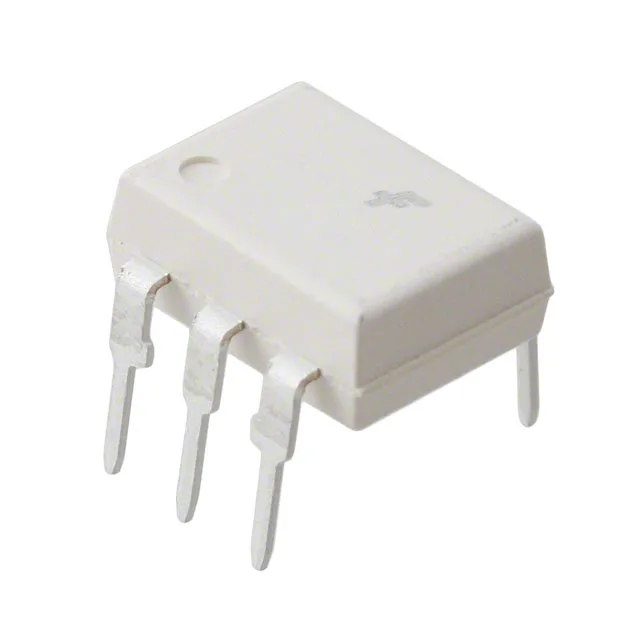
What the 4170 Vrms and 800 V off-state mean for your AC load
The MOC3072M isolates low-voltage control logic from a 240 VAC line with 4170 Vrms of isolation and an 800 V off-state blocking voltage. That gives you nearly 2.4× headroom above the 340 V peak of a 240 VAC sine wave, so transient spikes from inductive loads or line switching won't punch through the output triac. The non-zero-crossing output means the internal LED can trigger the triac at any point in the AC cycle — essential for phase-angle dimming, soft-start motor control, or any application where you need to fire the load partway through a half-cycle. If your design only needs on/off at the zero crossing, a zero-crossing optotriac like the MOC3063M would simplify the drive.
Noise immunity and trigger current — bench-fit checks
A minimum static dV/dt of 1 kV/µs means the output triac won't falsely commutate on fast voltage edges from nearby relays, motor drives, or switching power supplies. In a panel with a VFD running at 4–8 kHz carrier frequency, that margin keeps the load from turning on when you didn't command it. The LED trigger current (Ift) is 10 mA max, and the typical hold current (Ih) is 540 µA. A 5 V logic output driving a 330 Ω series resistor delivers about 12 mA — enough to saturate the LED over temperature. The 60 mA absolute max DC forward current gives you room to drive it harder if the LED degrades over life, but staying near 10–15 mA keeps the thermal stress low.
ROHS3 compliant and UL recognized.
Sourcing and ordering this part
No stock-holding claim; every order is confirmed at quote time.