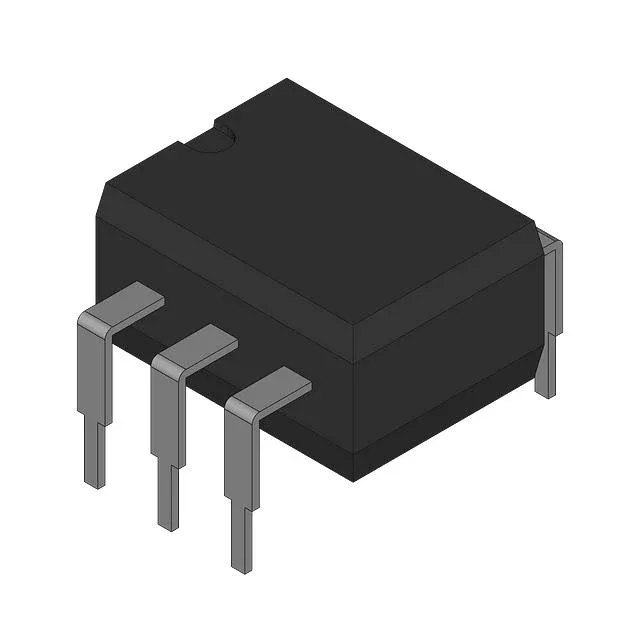
What this optocoupler does and who specifies it
The CNY174TVM is a single-channel optocoupler from onsemi with a DC input LED and a phototransistor output that includes a base terminal. The headline rating is 4170Vrms isolation between input and output — that is enough for reinforced insulation in 240VAC line-connected circuits, and it gives headroom for transient overvoltages common in factory-floor equipment. Current transfer ratio runs from 160% minimum to 320% maximum, both measured at If=10 mA. That spread means the designer sizes the pull-up resistor for the worst-case minimum CTR; the high ceiling is useful if you want to run the LED at lower current to save power or extend LED life.
Switching speed and output drive — what the timing specs mean for your BOM
Turn-on time is 2 µs typical, turn-off 3 µs typical, with rise/fall times of 4 µs and 3.5 µs maximum. That puts this part in the general-purpose opto range — fine for 10–50 kHz switching regulators or 1–2 ms PLC input sampling, but not for high-speed isolated data links. The output transistor is rated for 70V collector-emitter and can sink 50 mA continuous per channel. That 70V ceiling is handy for driving a 24V PLC input directly without a level-shift transistor. Vce saturation is 400 mV maximum at the rated output current — low enough that the voltage drop across the opto does not steal much headroom from the downstream logic supply.
The DIP package is field-service-friendly: you can swap it on site with a standard soldering iron and a solder sucker — no hot-air station needed.
Because the CNY174TVM is active and in a standard DIP package, it is widely available through multiple distribution channels. The forward voltage is 1.35V typical at If=10 mA, and the absolute maximum forward current is 60 mA. That is a standard LED drive — any 3.3V or 5V logic output with a series resistor can drive it.