Triac output with zero-crossing — what it means for the load
The MOC3063SR2M integrates a Triac output stage with a zero-crossing circuit, meaning the output switches on only near the AC line voltage zero crossing. This minimizes inrush current when driving inductive or resistive loads like solenoids, relays, or small motors, and reduces EMI generation at turn-on. Rated for 600 V off-state voltage and a minimum static dV/dt of 600 V/µs, the output withstands high-voltage transients without false triggering — a critical parameter for noisy industrial AC lines where fast-rising spikes could otherwise commutate the Triac on unexpectedly.
Isolation and drive margin
With 4170 Vrms isolation (one-minute test), the part provides reinforced insulation between the low-voltage control side and the AC mains side — suitable for applications requiring a safety barrier per UL 1577. The LED trigger current (Ift) is 5 mA maximum, so the microcontroller GPIO can drive it directly through a series resistor without a buffer transistor. Hold current (Ih) is 500 µA typical — once triggered, the Triac stays latched until the load current drops below this threshold near the AC zero crossing, which is the normal commutation point for a zero-crossing switched circuit.
Package and board-fit for surface-mount assembly
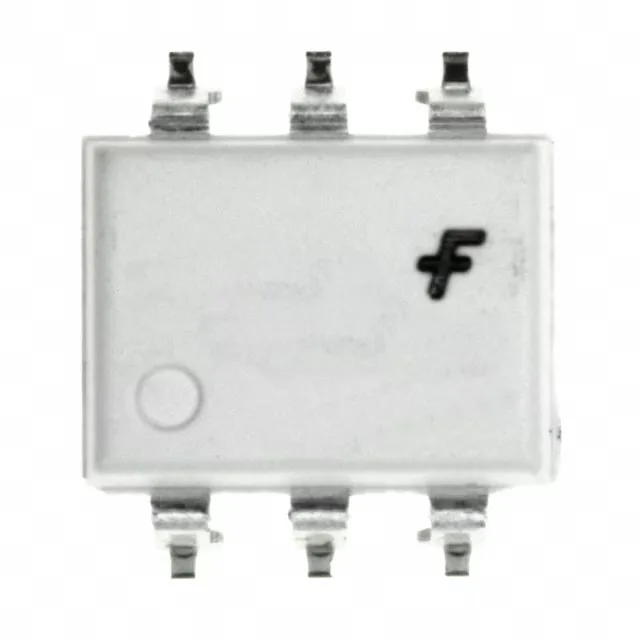
Supplied in a 6-SMD gull wing package (6-SMD, Gull Wing), the part is compatible with standard reflow soldering profiles. The supplier device package is designated 6-SMD. The surface-mount footprint matches the common DIP-6 gull-wing layout, so existing PCB designs for through-hole MOC306x parts require a layout change to the SMD pattern.
Active lifecycle and compliance — sourcing note
No pin-compatible direct replacement is listed — the MOC3063SR2M is the surface-mount variant of the base MOC3063 series.