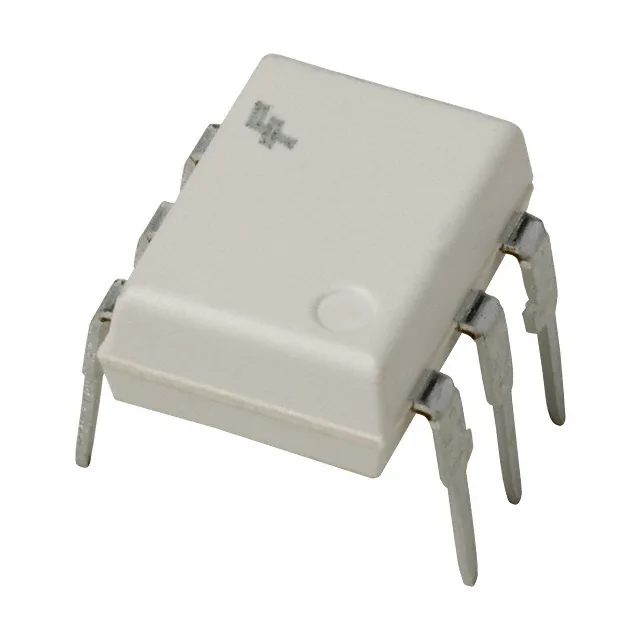
What this optotriac does on the board
The MOC3021M is a 1-channel optoisolator with a triac output from onsemi, built to switch AC loads from a low-voltage logic or microcontroller signal while keeping the two sides galvanically separated. The 4170 Vrms isolation rating means it can sit across the mains isolation barrier in equipment like solid-state relays, motor starters, or lighting controls without flashover. Because it has no zero-crossing circuit, the triac fires at whatever point in the AC cycle the LED turns on. That makes it a fit for phase-angle dimming or soft-start applications where you need to trigger partway through the half-cycle, not just at the zero crossing.
Key ratings for your BOM decision
Off-state voltage is 400 V, so the triac blocks line voltage up to 400 V peak when off. That covers 120 VAC and 240 VAC mains with margin. The LED trigger current is 15 mA max — a standard 20 mA LED drive from a 5 V logic rail through a 220 Ω resistor will fire it reliably. Forward voltage is 1.15 V typical, and the LED can take up to 60 mA continuous without damage. Hold current is 100 µA typical — once the triac latches, it stays on as long as the load current stays above that threshold. Below 100 µA the triac drops out at the next zero crossing, which is normal for resistive loads. Inductive loads need a snubber network to keep the dV/dt below the triac's commutating limit.
onsemi lists the MOC3021M as Active and ROHS3 compliant.