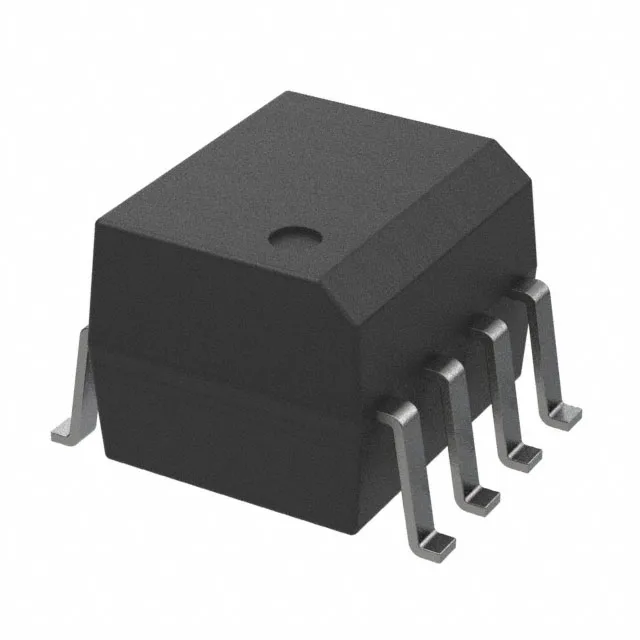
The MOC207M provides 2500Vrms galvanic isolation between input and output. That figure is the one-minute withstand voltage per UL1577 — for a 250 VAC or 60 VDC working voltage, the margin is comfortable; for 400 VDC bus isolation you need a higher-rated part. The 8-SOIC footprint saves board space compared to DIP-8, but the creepage distance is shorter, so keep the isolation barrier clear of copper on adjacent layers.
CTR range and drive current sizing
Current transfer ratio is specified at 100% minimum, 200% maximum, both at If=10 mA. A CTR of 100% means 10 mA LED current can sink 10 mA at the output — enough to drive a logic gate input or a low-power relay coil. The 150 mA absolute maximum output current is a ceiling, not a continuous rating; the practical limit is set by the CTR and the 30 V output breakdown. If the load needs more than 10 mA, increase the LED drive proportionally, but stay under the 60 mA absolute maximum forward current.
Rise time is 3.2 µs typical, fall time 4.7 µs typical. Turn-on time is 7.5 µs, turn-off 5.7 µs. For a 10 kHz PWM signal (100 µs period), the rise and fall edges consume about 8% of the period — acceptable for many industrial I/O interfaces. For 100 kHz serial data, the timing asymmetry will distort the duty cycle; consider a logic-output optocoupler instead.
onsemi lists the MOC207M as Active and ROHS3 compliant.