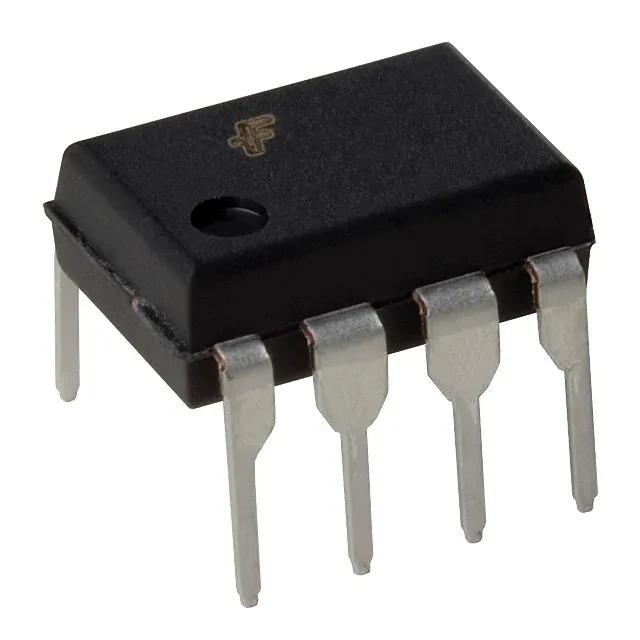
AC/DC input optoisolator for line-voltage sensing
The HCPL3700M from onsemi is a single-channel optoisolator that accepts both AC and DC inputs — a feature that lets it directly sense mains-voltage presence (e.g., 120/240 VAC) through a simple resistor divider, without an external rectifier bridge. Its 5000Vrms isolation rating provides the safety margin needed for industrial control, motor drives, and power-supply monitoring where the input side may be at line potential and the output side connects to a low-voltage logic or PLC input. The Darlington output delivers up to 30 mA per channel at 20 V max, enough to drive a relay coil or a PLC input module directly, but the 45 µs typical rise time means the switching speed is limited to a few kilohertz — not for high-speed data.
Packaged in tubes (the standard DIP-8 through-hole format), the HCPL3700M is also available in tape-and-reel for SMT assembly as the HCPL3700SVM — same die, different package. For volume requirements, the tube quantity is typically 50 per tube; confirm the exact reel/tube quantity when quoting.
The 8-DIP (0.300-inch, 7.62 mm) through-hole package is a standard footprint that fits into sockets or solders directly into plated-through holes. The 0.100-inch pin pitch is breadboard-friendly and easy to probe during bring-up. For extended-range needs (e.g., 105°C or 125°C), look at the 4N29M which is rated to 100°C, but note its lower isolation (4170Vrms).
Switching timing and output drive
Turn-on time is 6 µs typical, turn-off is 25 µs typical — the asymmetry is due to the Darlington pair's storage time. This means the output stays on longer than off for a symmetric input waveform; account for the 25 µs turn-off delay in timing budgets for fault-detection or zero-crossing circuits. The rise/fall times (45 µs rise, 0.5 µs fall) indicate the output switches off much faster than it switches on. For applications like AC line-cycle monitoring (50/60 Hz), the 6 µs turn-on is negligible; for higher-frequency PWM or serial data, the Darlington output will limit throughput. Maximum output voltage is 20 V, and continuous output current is 30 mA per channel — enough to drive a 5 V or 12 V logic input, a small relay (e.g., 5 V, 20 mA coil), or an LED indicator. For higher-current loads, use the output to switch an external transistor or MOSFET.