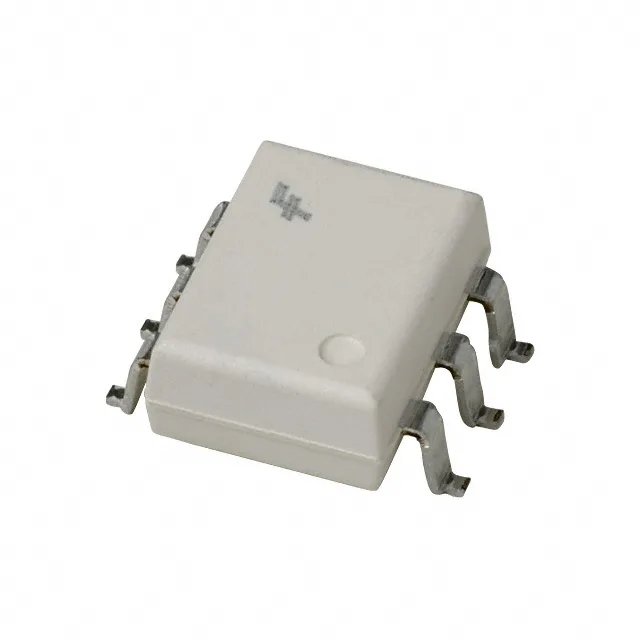
4170Vrms isolation in a 6-SMD gull-wing package
The H11D3SR2M is a single-channel DC-input optocoupler from onsemi, rated for 4170Vrms isolation between input and output. That isolation voltage qualifies it for industrial-grade barrier separation — motor drives, PLC digital inputs, and isolated sensor interfaces where 4 kV class is the minimum. The output is a phototransistor with base access, giving the designer the option to bias the base for faster switching or to use the base as a third terminal for feedback.
CTR floor and switching speed
Minimum current transfer ratio is 20% at If=10 mA. The typical turn-on and turn-off times are both 5 µs, which suits signal isolation up to about 10 kHz. For faster edges, the base-access pin allows a base-emitter resistor to speed up turn-off. Maximum output voltage is 200V, and continuous output current per channel is 100 mA. The 400 mV Vce saturation at rated current keeps the on-state voltage drop low, minimising power dissipation in the output stage.
Active production, ROHS3, and ordering options
The closest peer in the same family is the H11AA1SR2M, which accepts both AC and DC input — useful if the input polarity is unknown. The 4N25SR2M offers faster switching (2 µs typical) but a lower 500 mV Vce saturation ceiling.