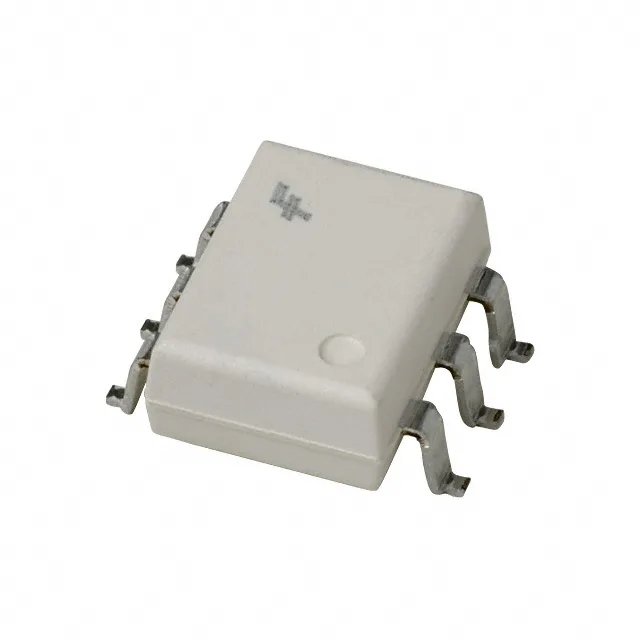
onsemi H11B1SR2VM — Optoisolators

onsemi H11B1SR2VM Optoisolator, Darlington Output, 4170 Vrms

MPNH11B1SR2VM
End of Life

onsemi H11B1SR2VM optoisolator, 1-channel DC input, Darlington with base output, 4170 Vrms isolation, 500% min CTR at 1 mA, 150 mA output, 6-SMD Gull Wing, Bulk.

$0.88Ref. price · indicative, final on quote
Packaging6-SMD, Gull Wing
StockIn Stock (21)
Lead timeIn Stock wk
MOQ1 pcs
  • 100% new & originalTraceable channels only — no refurbs, no pulls, no remarked parts.
  • Date & lot codes on quoteStated per line before you commit; label photos on request.
  • MSL-compliant ESD packingMoisture-sealed bags with indicator cards; reels photo-verified.
  • PayPal buyer protectionPay by T/T, PayPal or Payoneer — card payments covered end to end.

Specifications

H11B1SR2VM Technical Specifications
ParameterValue
Input typeDC
Output typeDarlington with Base
Mounting typeSurface Mount
Voltage - isolation4170Vrms
Voltage - output30V
Voltage - forward (Vf)1.2V
Current - output (Channel)150mA
Current transfer ratio500% @ 1mA
Current - DC forward (If)80 mA
Operating temperature-40°C ~ 100°C
PackageBulk
Case6-SMD, Gull Wing
Number of channels1
Vce saturation1V
Turn on (Turn off time)25µs, 18µs

Product details

Darlington output with base access — what it means for the BOM

The H11B1SR2VM is a 1-channel optoisolator from onsemi with a Darlington phototransistor output that brings the base terminal out to a separate pin. This base-access pin lets you add a speed-up resistor or a pull-down to tailor the switching threshold and turn-off time — useful when driving a logic input that needs a clean edge rather than a slow Darlington saturation ramp. Rated for 4170 Vrms isolation, the part provides galvanic separation between a low-voltage DC control side and a higher-voltage load side, with the output capable of sinking 150 mA continuous at up to 30 V. The minimum current transfer ratio of 500% at 1 mA forward current means the LED drive current can be kept low — a 1 mA input yields at least 5 mA of collector current at the output, which is enough to saturate the Darlington pair and drive a relay coil or a PLC input module directly.

Switching speed and the base-pin trade-off

Turn-on time is 25 µs typical, turn-off 18 µs typical — these are slower than a standard phototransistor opto because the Darlington pair's internal gain stores more base charge. The base pin lets you add a resistor between base and emitter to speed up turn-off at the cost of reduced effective CTR; without it the part is best suited for DC-level or low-frequency switching (below ~10 kHz) where the 25 µs delay is negligible. Operating temperature spans -40°C to 100°C, covering industrial cabinet and appliance environments. The 6-SMD Gull Wing package is reflow-compatible and occupies the same footprint as the industry-standard 6-pin DIP Gull Wing — no board spin needed if migrating from a through-hole H11B1 variant.

Frequently asked questions

Will H11B1SR2VM drop into a board designed for 4N25SR2M?

The H11B1SR2VM and 4N25SR2M share the same 6-SMD Gull Wing footprint and 4170 Vrms isolation rating, so the mechanical fit and creepage are identical. The functional difference is output type: the H11B1 uses a Darlington pair with base access (500% min CTR, 25 µs turn-on), while the 4N25 uses a single phototransistor (100% min CTR, 2 µs turn-on). If the downstream circuit expects the higher gain and slower switching of a Darlington, the H11B1 is a drop-in; if it needs the faster edge of a transistor output, the 4N25 is the closer match.

What is the input type and output configuration?

DC input on the LED side, Darlington with base on the output side. The base pin is brought out separately, allowing external biasing or speed-up components.